Reading the Letters on the Text’s Own Terms
Begin with what the book says it is. The Qur’an does not present itself as an anthology of curiosities; it presents itself as revelation, a book sent down by God to make Him known and to call its hearers to account, and every other claim it makes stands under that one. A fair test has to start there, because the theology is the claim. And the theology has a consequence for method: if the book is what it says it is, nothing in it is random, and the details least explained deserve the closest look, not the least. Twenty-nine openings made of letters that appear to spell nothing are the most conspicuous of those details — a quarter of the surahs, called signs at eight of them, preserved letter for letter by every reading tradition for fourteen centuries. A reader who takes the text as revelation cannot treat its strangest words as filler, and a reader who takes it as human still has to explain why its author put them at the head of the chapter and its reciters never let them go. Either way, they are evidence, and the text’s own first command — read — does not exempt them.
The book also says what kinds of verses it contains, and it does not say they are all equally plain. “It is He who has sent down to you the Book; in it are verses that are precise (muḥkamāt), they are the foundation of the Book, and others that are ambiguous (mutashābihāt). As for those in whose hearts is deviation, they follow what is ambiguous, seeking fitnah and seeking its interpretation” (). The text predicts that part of it will divide its readers, and that the quarrel over it is part of what it is. The word it uses for what the quarrel produces says why. The root f-t-n means, at its origin, to put gold into the fire so that the good shows apart from the bad (al-Rāghib al-Iṣfahānī, Mufradāt; Lane, s.v. f-t-n), and the Qur’an uses fitnah in that refining sense throughout: “Do people think they will be left to say ‘We believe’ and not be tried? We tried those before them, so God will make evident who are truthful and who are liars” (); the trials at Uḥud came “so that God may purify those who believe” (). In two parties stand in the same sentence. The trial is God’s, and its purpose is to refine; the seeking of fitnah belongs to those whose hearts deviate, who chase the ambiguous verses to stir up doubt, and the verse condemns them for it. Taken on its own terms, then, a puzzle that splits readers is not a defect in such a book. It is what the book says it contains.
The letters are an obvious candidate for the second kind. Verse does not name them, so placing them among the mutashābihāt is an interpretation, but it is an old one. Al-Qurṭubī reports that al-Shaʿbī, Sufyān al-Thawrī and a group of the hadith scholars called the letters “God’s secret in the Qur’an,” of the mutashābih whose knowledge He kept to Himself, and Ibn Kathīr records the same position from Abū Bakr, ʿUmar, Uthman, ʿAlī and Ibn Masʿūd (both on ). The earliest story of anyone trying to decode them, the Medinan Jews who computed the lifespan of the new religion from the letters’ numerical values, is told in the commentaries as the occasion on which was revealed. The chain is weak, running through al-Kalbī, and Ibn Kathīr says so; but the link between the letters, counting and the fitnah of is in the tradition, not invented here.
There is a second reason to look at the letters, and it comes from the text and from the scholars who read it most closely. At eight of the twenty-nine openings the words that follow the letters are tilka āyātu l-kitāb, “these are the signs of the Book,” or a close variant (10, 12, 13, 15, 26, 27, 28 and 31), and at others dhālika l-kitāb, “that is the Book.” The demonstrative points at something just presented, and what has just been presented is the letters. That is not this chapter’s private reading. Nöldeke judged it “scarcely accidental” that so many of these surahs open by naming the Book; Alford Welch proposed that the formulas “appear to refer back to the letters”; and Marijn van Putten reads tilka l-āyāt the same way — “those signs, i.e. signs of writing, letters!” If they are right, the text calls the letters āyāt, and āyāt is exactly the word divides into the precise and the ambiguous. The letters are then not merely a candidate for the divisive kind of sign; the text has put them in the category where, on its own account, the division happens.
The number belongs to the same pattern. At the text calls the number nineteen a fitnah; at it says fitnah is what is sought in the ambiguous āyāt; and the letters it calls āyāt are the strangest in the book. Here, though, the chapter has to be careful about whose argument it is making. What calls a fitnah is the number (“We have made their number only as a trial for those who disbelieve”), not the letters, and no verse joins them. Joining the two, so that a count of the letters by nineteen becomes the trial, is this chapter’s reading. It is built in the open below, where the chapter calls it the bridge, and the reader should hold it as a reading, not as what the verse says.
If the reading is right, it can be checked, and the audit that fills most of this chapter is the check: whether the letters, counted, really do divide, and whether they divide where the text said its signs would, or whether they behave like any other letters. And whatever the audit finds, it cannot compel. The text says as much of every sign it offers (“If We willed, We could send down from heaven a sign so their necks would bow to it,” ), and its own narrative places the first refusal of God under overwhelming evidence (). A sign that divides cannot end skepticism about God, and the chapter does not ask it to.
That is the spine of what follows: the text’s claim to be revelation; its own prediction of clear verses and divisive ones; the letters as a candidate for the divisive kind; the audit, which tests whether they divide; and the point that skepticism survives any sign. It changes what the long controversy over the letters is evidence of. On the text’s own terms, a fourteen-century quarrel over them is what it said would happen. The controversy becomes data about the text, not a verdict on the people who doubt the count, and not a verdict for the people who accept it.
The Puzzle: A Fourteen-Century Mystery
Surah Qaf · 50:1ققٓۚ وَٱلۡقُرۡءَانِ ٱلۡمَجِيدِQāf. By the glorious Qur’an.Arabic: Uthmani text via quran-json
A single letter, and then an oath. Surah 50 opens with the name of the letter qāf — not a word that begins with it, not an abbreviation, the letter itself, recited as a letter — and in the same breath swears by the glorious Qur’an. The reader is told nothing about why the letter is there. The surah goes on, for forty-five verses, and never comes back to it.
Surah Yusuf · 12:1يوسفالٓرۚ تِلۡكَ ءَايَٰتُ ٱلۡكِتَٰبِ ٱلۡمُبِينِAlif Lām Rā. These are the signs of the manifest Book.Arabic: Uthmani text via quran-json
Three letters this time, alif, lām, rāʾ, and then a sentence that points at them: these are the signs of the manifest Book. Here the text does say something about the letters — it calls them signs — but it does not say what they signify, and the surah that follows is the story of Joseph, which never mentions them again. Two openings, two sets of bare letters, one followed by an oath and one by a label, and in neither case a word of explanation.
For fourteen centuries readers have wondered why the author of the Qur’an placed these initials at the heads of its chapters. The question has never been settled, and the mystery is the subject of this chapter.
Twenty-nine of the Qur’an’s one hundred and fourteen surahs begin with letters that appear to spell nothing. Alif lām mīm. Ḥā mīm. Kāf hā yā ʿayn ṣād. Ṭā sīn. Qāf. Nūn. Fourteen letters of the alphabet — exactly half of it — in fourteen combinations, set at the head of a surah before its first sentence, and recited by every reader in every tradition for fourteen centuries as bare letter-names: not as a word, not as an abbreviation, but as the letters themselves, with nothing beside them to say what they are for.
The text never explains them. That is the first fact about them, and the one everything else turns on.
People have been trying to explain them since the first generation, and the earliest attempt on record was numerical. A report carried by Ibn Isḥāq has the Jews of Medina hear alif lām mīm and go to work: alif is one, lām thirty, mīm forty — seventy-one years, the lifespan of this religion. They asked whether there were others, and were given alif lām mīm ṣād, one hundred and sixty-one; alif lām rāʾ, two hundred and thirty-one; alif lām mīm rāʾ, two hundred and seventy-one — at which point, the report says, they gave it up as too obscure. The tradition carries that story on a weak chain and without endorsement, but it carries it, and it tells you one thing: the very first readers who tried to crack the letters reached for numbers.
The Companions, by most reports, declined to try. “In every book there is a secret,” Abū Bakr is reported to have said, “and the secret of this book is its openings.” Ibn Kathīr, gathering the tradition in the fourteenth century, states the position plainly — these are among the things whose knowledge God has kept to Himself, as reported from Abū Bakr, ʿUmar, Uthman, ʿAlī and Ibn Masʿūd — and then, in the same breath, records a different and growing view from al-Zamakhsharī, al-Rāzī and Ibn Taymiyya: that the letters are a challenge, that the Qur’an is made of the same twenty-eight letters its hearers speak with, and here they are, produce something like it. Neither view made the letters a matter of number: the classical doctrine of the Qur’an’s inimitability (iʿjāz), as al-Bāqillānī and al-Jurjānī developed it, located the miracle in its eloquence and composition (naẓm), and the question this chapter asks is a modern one. Al-Rāzī counted some twenty opinions in circulation by his day. They were initials of the divine names. They were oaths. They were a tally of years. They were sounds to wake the audience before the sermon. The mystics read them as keys. The commentators noticed that the fourteen letters used are half the alphabet and that they fall, class by class, in roughly even halves, as though chosen to stand for the whole. Ibn Kathīr records a mnemonic for the fourteen: they can be gathered into the phrase naṣṣun ḥakīmun qāṭiʿun lahu sirr, “a wise, decisive text that has a secret” (Tafsīr, ), offered as a pleasing aside rather than as their meaning. The letters were impossible not to notice, and every generation that noticed them used the freedom they leave — which letters, grouped how, read as what — to try to make them speak. That freedom is the hazard this chapter has to manage, not only to use.
The modern academy took its turn and did no better at agreement. Nöldeke at first thought them the monograms of the men who owned the codices, and by 1892 had given that up: he now judged it “more probable that they are to be traced to the Prophet himself,” found that it “can scarcely be accidental” that most of these surahs open with “This is the book” or an equivalent, and concluded that the letters were meant “for a mystic reference to the archetypal text in heaven.” He cited as the Qur’an’s own admission that it contains things not meant to be understood, and he warned that reading the letters as ciphers was “a precarious hypothesis” (Nöldeke, “The Koran,” in Sketches from Eastern History, trans. J. S. Black, London, 1892, pp. 21–59; an earlier version formed part of the article “Mohammedanism” in the Encyclopædia Britannica, 9th ed., vol. XVI, and Nöldeke says it was considerably revised for this collection). Hirschfeld matched them to names. Bellamy argued they were corrupted abbreviations of the basmala. Massey read them as an ordered list of initials. Stewart set them beside the formal openings of Greek and Babylonian oracles. Luxenberg took them for Syriac. Nguyen, surveying the Sunnī commentaries in 2012, called them a paradigmatic case of the mutashābih — the ambiguous — and described a tradition that had spent a thousand years generating readings without converging on one. The Leiden philologist Marijn van Putten, asked in 2026, put the state of the question in three observations: the letters usually rhyme with the verses that follow, so they are “certainly intended to be part of the recited text”; surahs that share letters cluster together, in the order of the codex and in theme, the Ḥā-Mīm surahs being his example; and the letters are usually followed by dhālika l-kitāb or tilka l-āyāt — “those signs, i.e. signs of writing, letters!” — which he takes to point back to the letters themselves. Alford Welch had proposed the same reading of those formulas, that they “appear to refer back to the letters,” and argued that the letters are part of the revelation (abstract of his paper for “The Qur’an in Its Historical Context,” University of Notre Dame, April 2009). “I don’t think anything is particularly satisfying,” he wrote, “but we’ve made some progress” (posts on X, 30 October 2026: 1, 2, 3).
Fourteen centuries. Twenty classical opinions. Half a dozen modern ones. No answer.
Almost no one in that long line asked the text itself — not what the letters mean, which it does not say, but what it says about them, in its own words, in the verses that stand beside them. Because it does say something. At eight of the twenty-nine openings the very next words call the letters signs. At the head of the one surah that is about a number, it sets a number and calls the number a trial that will divide its readers — and that surah is al-Muddaththir, “The Cloaked One,” the one wrapped up, the thing covered over. The name is addressed to the Prophet in his mantle at its first verse, and the chapter claims nothing more for it than that; but a reader who has come this far may be forgiven for noticing that the surah which sets the puzzle is the one named for something hidden. It says of itself that it has counted all things, and that it is guarded. It commands the reader, as its first word and again at , to investigate rather than accept. And at it writes down, in advance, the sentence the puzzled will say when they meet the number: mādhā arāda llāhu bi-hādhā mathalan — “what does God mean by this as an example?” That is the sound of someone turning a puzzle over in their hands. The text does not just set the puzzle; it describes the reader holding it.
Put the text’s own statements together and the letters stop looking like a secret withheld and start looking like a puzzle set — pieces named, rule left to the solver, reception predicted. Within the frame set out at the start, that is the hypothesis of this chapter: that the mysterious letters are not a mystery the text forgot to solve but one it built, and that it told us so. The chapter works it the way a puzzle is worked, in order. First it anchors the puzzle in what the text actually fixes. Then it asks what a number set over a text could be for, and finds that the text’s own claims — counted, guarded, a trial — describe something a modern reader would call a check on transmission. Then it goes where that hypothesis sends it: into the history of how a recitation became a page, and into the discipline that studies that history, because a check on transmission can only be read by someone who knows what the transmission did. And then it counts — from the letters the transmission never touched, which divide on every page ever written, down to the one letter it never stopped touching, which fails everywhere — and finds that the line between the two is the line the text drew. The reader should not take any of that on the chapter’s word, because the text itself says not to. Read.
The Puzzle, A Mystery Anchored
Before the pieces, a word on why this evidence is of a different kind from everything before it. The first seventeen chapters ran from text to finding: read a verse, set it beside a modern result, ask whether the match is real — and every one of them remains vulnerable to the same objection: that its apparent fit could be produced by semantic elasticity, the match noticed only after the result was known. The Introduction argued that lens-invariance requires specificity as well as survival, and the chapter does not withdraw that; it concedes the objection, not the verdict. Here the direction reverses. The text names a number, places a set of unexplained letters at the heads of twenty-nine surahs, labels those openings, claims to have counted, commands the reader to check, and predicts the shape of what any test will produce — all before any test is performed. It fixes the ingredients and the way the outcomes are to be sorted. What it does not fix is the arithmetic that connects them; that is the analyst’s, and the chapter says so wherever it supplies it. The analyst is therefore not asked to find a match. The analyst is asked to choose an operation, perform it against targets the text fixed, and discover whether the result divides in the way the text said it would. The full statement of that contrast is preserved in Appendix D.
A puzzle has to be anchored before it can be worked: the solver has to know which pieces are given and which are his to supply. The chapter borrows a word from experimental science for the pieces that are given, and defines it once. A claim is pre-registered when it is written down before the test that bears on it, in a form that constrains what a faithful test must look like, so that the tester cannot adjust the claim to fit the result. That is the bounded sense the chapter uses throughout: a pre-registration is a claim the text makes, in its own words, that fixes an ingredient of the test or the way its outcome is to be sorted, and that any reader can find on the page before any count is run. The Qur’an makes five such claims. They are listed here in the plainest form, with the verse that carries each, so that the line between what the text fixes and what the chapter infers is drawn once and kept in view. Pre-registrations do not fix the operation — that is supplied below, and marked as supplied.
Pre-registration 1: the targets, and what the text says each of them is. At the openings of twenty-nine surahs the text places disconnected letters and, in the very next words, states what those letters stand in relation to; every one of those statements was on the page a millennium before any modern count, and the chapter comes back to all twenty-nine in a moment. The one that matters most is the sign label. At eight of the twenty-nine openings the words that follow the letters are tilka āyātu l-kitāb — “these are the signs of the Book” — or a close variant: Surahs 10, 12, 13, 15, 26, 27, 28 and 31. The demonstrative tilka stands directly beside the letters it refers to. The other twenty-one openings say something else after their letters: they swear by the recitation, declare it sent down, name the Book, or say nothing. No commentary supplies the label and no translation choice creates it; it is on the page.
Pre-registration 2: the number. In Surah 74, after a passage on the disbelievers and the fire that awaits them, the text delivers a line unlike any other in it.
Surah Al-Muddaththir · 74:30المدثرعَلَيۡهَا تِسۡعَةَ عَشَرَʿalayhā tisʿata ʿashar. “Over it are nineteen.Arabic: Uthmani text via quran-json
Four words, isolated, explicitly numerical — and in a surah that opens with no letters at all, so that the number cannot be accused of counting its own. The verse has an early witness. Marcel 3, in the National Library of Russia, is part of a Ḥijāzī codex radiocarbon-dated to 652–763 CE at 95.4 per cent, with 89.3 per cent of that probability in 652–694; its Paris portion is one of the fourteen manuscripts from whose shared spellings van Putten argued the single written archetype. Its folio 20 recto carries –49, and the Corpus Coranicum transcription of that leaf gives ʿalayhā tisʿata ʿashar as witnessed, with no letter flagged as missing, while flagging a missing letter in the adjacent — so the absence of a flag is an editorial statement, not silence. No facsimile has been published, and the chapter has not seen the leaf. Short of that, the physical record puts these four words on a page the radiocarbon places, with nine chances in ten, in the seventh century.
Pre-registration 3: the division, and the reader’s question. The next verse says what the number is for.
Surah Al-Muddaththir · 74:31المدثروَمَا جَعَلۡنَآ أَصۡحَٰبَ ٱلنَّارِ إِلَّا مَلَـٰٓئِكَةٗۖ وَمَا جَعَلۡنَا عِدَّتَهُمۡ إِلَّا فِتۡنَةٗ لِّلَّذِينَ كَفَرُواْ لِيَسۡتَيۡقِنَ ٱلَّذِينَ أُوتُواْ ٱلۡكِتَٰبَ وَيَزۡدَادَ ٱلَّذِينَ ءَامَنُوٓاْ إِيمَٰنٗا وَلَا يَرۡتَابَ ٱلَّذِينَ أُوتُواْ ٱلۡكِتَٰبَ وَٱلۡمُؤۡمِنُونَ وَلِيَقُولَ ٱلَّذِينَ فِي قُلُوبِهِم مَّرَضٞ وَٱلۡكَٰفِرُونَ مَاذَآ أَرَادَ ٱللَّهُ بِهَٰذَا مَثَلٗاۚ كَذَٰلِكَ يُضِلُّ ٱللَّهُ مَن يَشَآءُ وَيَهۡدِي مَن يَشَآءُۚ وَمَا يَعۡلَمُ جُنُودَ رَبِّكَ إِلَّا هُوَۚ وَمَا هِيَ إِلَّا ذِكۡرَىٰ لِلۡبَشَرِAnd We have appointed only [stern] angels as wardens of the Fire. And We have made their number only as a trial for the disbelievers — so that those who were given the Scripture may be convinced, and those who believe may increase in faith. And those who were given the Scripture and the believers may not doubt. And so that those in whose hearts is disease and the disbelievers may say, “What does Allah intend by this as an example?” Thus does Allah leave astray whom He wills and guide whom He wills. And none knows the soldiers of your Lord except Him.Arabic: Uthmani text via quran-json
Read what this verse does. It does not say the number is significant; it says the number is a trial — fitnah — and that the trial will produce two responses, certainty in some and dismissal in others. It names the mechanism: this is how guidance and misguidance distribute themselves across an audience. And it writes down the question the number will provoke: “what does God mean by this as an example?” The verse puts the words in the mouths of those who stop at them, but the question itself is not the mark of a dismisser; it is the response of anyone to a puzzle, and a reader can ask it with full conviction and go on to work the answer out. The division the verse predicts is not between those who ask and those who do not. It is between those who ask and stop, and those who ask and read. Nothing else in the Qur’an makes a prediction of this shape — a quantity named, its count given an epistemic function, and the structure of its reception described in advance.
One historical qualification belongs here, before anything is built on these two verses, and Appendix D carries it in full. Most historical-critical scholarship reads as a later, Medinan addition to the short verse before it. Nöldeke, who first argued it in 1860, held that Muhammad himself inserted it, because it names the four groups he faced in Medina; Schwally’s revision calls it an interpolation “perhaps” from the Prophet; Lange calls it a gloss — and the classical reports attach the verse to Abū Jahl’s mockery of the number of the Fire’s wardens at Mecca. The strong form of the critical view, a gloss by a later hand, is the least supported: the scholar who founded the view attributed the verse to Muhammad, the verse closes on the surah’s own rhyme with the very words that close , and on Lange’s own account the verse clarifies who the nineteen are, angels, but leaves the number itself unexplained and calls it a trial instead (Appendix D gives the case in full). Even so, the chapter needs neither reading to be otherwise. If is later, the prediction was fixed in the canonical text in the first century rather than heard at Mecca; it still stands on the page some thirteen centuries before anyone set the number beside the openings and asked. And an occasion of revelation explains why a verse came down, not the boundary of what it says — al-ʿibra bi-ʿumūm al-lafẓ lā bi-khuṣūṣ al-sabab, the exegetes’ own rule: the wording is general, and a seventh-century division over the wardens and a modern division over a count are two instances of what it describes, not competitors for one slot. A reader who holds that the only legitimate reading is the Meccan one, closed at its occasion, has a clean exit here, and the chapter hands it over rather than burying it: on that reading the bridge fails at its first plank and nothing downstream needs examining. It is the cheapest way to set the chapter aside, it is available on the first page, and it is a legitimate reading; the chapter records the fork and passes no judgment on the reader who takes it. There will be more such exits. Each is real.
Pre-registration 4: the counting, and the guarding. At the text says of God that He has counted all things by number — wa-aḥṣā kulla shayʾin ʿadadan — with ʿadad, the explicit word for number, as the last word of the surah; at that everything has been enumerated in a writing; at , in a clear register. None of these says “count the letters.” What they say is that counting is the kind of operation this book has in view — that if a reader takes the puzzle to be arithmetic, the text has already answered: yes, We have counted. And at it says of itself that it is guarded — innā lahu la-ḥāfiẓūn, “We are its guardians,” the verse Chapter 3 is built on. Counted, and guarded. Hold those two beside the trial; the chapter will come back to them.
Pre-registration 5: the verification mode. The book’s first word is iqraʾ — read — and at it is made a rule.
Surah Al-Isra · 17:36الإسراءوَلَا تَقۡفُ مَا لَيۡسَ لَكَ بِهِۦ عِلۡمٌۚ إِنَّ ٱلسَّمۡعَ وَٱلۡبَصَرَ وَٱلۡفُؤَادَ كُلُّ أُوْلَـٰٓئِكَ كَانَ عَنۡهُ مَسۡـُٔولٗاDo not pursue that of which you have no knowledge. Indeed the hearing, the sight, and the fuʾād — each of these will be questioned.Arabic: Uthmani text via quran-json
The verse is addressed in the singular — that of which you have no knowledge — and the chapter reads it as an epistemic command: do not inherit claims; investigate what your faculties allow you to test. The step from the verse to that reading, and from the reading to the chapter’s use of it, is set out in Appendix D so that no one can say interpretation entered unmarked. What matters here is that the verification challenge this chapter issues at its close is not the chapter’s invention. The verse establishes the responsibility; the chapter’s extension of it to a checkable count is the chapter’s own.
Now the twenty-nine, because the first pre-registration is not one label but twenty-nine, and the chapter will test against all of them. What follows the letters at each opening falls into four forms — the division is this chapter’s own, drawn from the text rather than borrowed from an authority the tradition did not grant — and each form pre-registers something different about the opening it stands at. The sign form names the letters: tilka āyātu l-kitāb and its variants, at 10, 12, 13, 15, 26, 27, 28 and 31 — the only form the text ties to the number and to division. The Book form names the Book and stops: “this is the Book in which there is no doubt” (2), “He sent down to you the Book” (3), “a Book sent down to you” (7), “a Book whose signs are perfected” (11), “a Book We have sent down to you” (14), “the revelation of the Book” (32). The oath form swears by the recitation: by the wise Qur’an (36), by the Qur’an of the Reminder (38), by the glorious Qur’an (50), by the pen and what they inscribe (68), and by the manifest Book at 43 and 44, which open with an oath on the Book and answer it with a declaration, so that the chapter records them as dual. The descent form declares the source: “We have not sent down the Qur’an to you that you should be distressed” (20), “the revelation of the Book from God” (40, 45, 46), “a revelation from the Most Gracious” (41), and at 42, “thus He reveals to you,” a declaration by waḥy without the tanzīl formula. Three openings — 19, 29 and 30 — carry none of the four formulas, though each sets its letters in a passage addressed to revelation or to the testing of belief. The forms overlap, since al-kitāb sits inside most of the formulas, and the full catalogue, every opening with its verse, is in Appendix D. What the chapter rests on is not the taxonomy but the one feature cleanly present or absent at every opening: whether the letters are called signs. An oath, a declaration or a bare reference to the Book is a closed claim about what the recitation is, which a reader is asked to accept or reject; it is not a claim about a trial, and makes no prediction about it. The sign label is the one pre-registration the text ties to the number.
That is the pre-registration, in every sense this chapter needs, and the part of it that cannot be disputed is the part that needs no interpreting at all. Twenty-nine labelled openings, a number, a predicted division, a claim to have counted, and a command to check: all on the page thirteen centuries before anyone tested a count against them. No critic has to be persuaded that they are there. Everything after this point — what to count, how the number and the letters connect, which openings fall under the label and which do not — the text does not supply. It requires an interpretive bridge, and the chapter builds one in the open, plank by plank, saying at every plank what is the text’s and what is the solver’s. The pre-registration is the text’s and is not up for debate; the bridge is the chapter’s and is.
The man who first claimed to have solved the mystery
The puzzle was picked up, in the form this chapter works it, once — by a man who said he had solved it. Rashad Khalifa (1935–1990) was an Egyptian-born biochemist, trained in the United States, who in 1974 announced that the Qur’an was built on the number nineteen — the number names — and spent the rest of his life counting. His 1982 book, Quran: Visual Presentation of the Miracle, set out the counts he had assembled, among them the claim that the disconnected letters at the head of each surah occur in that surah a multiple of nineteen times; by the mid-1980s he had a list of seventeen such cases and had declared the matter a proven miracle. He is a controversial figure, and the chapter says why without flinching: he went on to declare himself a messenger of God, to reject the hadith literature wholesale, and to found a community in Tucson, Arizona, on those positions; mainstream Muslim scholarship rejected him as a heretic; and in 1990 he was murdered in his mosque. None of that is evidence about the letters, one way or the other, and the chapter uses none of it as such.
His solution has been criticised for forty years, and often rightly. The criticism, where it is right, is this. Four of his cases verify on any printed Qur’an under any way of counting: the letter qāf occurs 57 times in Surah 50, which opens with Qāf; 57 times in Surah 42, which opens with Ḥā Mīm ʿAyn Sīn Qāf; the seven Ḥā-Mīm surahs together carry 2,147 of their two letters, which is 19 × 113. Then the verification stops working. The alif cases — the six Alif-Lām-Mīm surahs, Alif-Lām-Rāʾ and their relatives, nine of the seventeen — do not reproduce his totals on any text a reader can buy; the numbers come close and miss, by a few letters or a few dozen, always in the alif. His own method cannot be rerun, because he never documented it in enough detail; several of his counts were shown to be wrong, some by his own followers; and the most careful work in his tradition, his community’s 2002 recount, recovers the totals by changing the text — a spelling emended here, a word there, on the authority of one manuscript or another — until the multiples return. Reproducing a number by adjusting the text until it appears is not verifying. Bilal Philips said so in 1987, Ziauddin Sardar said so, the Shahid Beheshti review said so, and on that point they were right. What they did not notice is that they, too, were counting a modern printed edition and treating it as the thing the verse was about. Rejecting the number because the adjustments are visible is no more a verification than making them.
But step back from the argument and look at the fact of it, because the fact is the first thing in this chapter that the text predicted. A number was announced; the audience split; the split has not closed in half a century. That is exactly what said a reader would see when the number was met: a trial — fitnah — producing certainty in some and dismissal in others. The verse describes a division over a sign, not which side of a modern count any reader stands on. Khalifa’s appearance, and the quarrel that followed him, is therefore not an embarrassment the chapter has to explain away. It is, on the text’s own terms, what the text said would happen: nineteen is called a fitnah, and it has caused the kind of controversy a fitnah causes. That is data about the text, not proof of it, and not a verdict on anyone who doubts the count — a quarrel over a number is also what an ordinary numerological claim produces, and the reader should weigh it as both. Whatever one makes of Khalifa’s own claims — and the Qur’an’s own accounts make plain that a trial can come through a false claimant as readily as through a true one, as it came through the Sāmirī () — he is the figure through whom the division over nineteen came, and his excesses are part of why it divided.
And the controversy is a challenge. scripts the question — what does God mean by this? — and answers it: do not take it on hearsay, use the hearing, the sight and the fuʾād you were given, and find out for yourself. The letters are written for a reason, and the reason is the challenge. He means for you to study — to go into the history of the writing, into the philology of a letter, into the readings — and to see whether you can solve the puzzle. Khalifa took the challenge and then stopped. Appendix 1 of his translation gives his totals — letter by letter for some cases, a bare sum for others — and cites exactly one manuscript, the Tashkent codex, for exactly one word: basṭatan at , which he says it writes with sīn. The citation cannot bear the weight: the Tashkent codex is not a first-century copy, its leaves at this point are missing or later replacements, every first-century codex that carries the word writes ṣād, and nowhere does he say which text the rest of his counts were made from. He never produced a complete data set that anyone could verify end to end. Instead he declared himself a messenger, emended the text without careful review or sourcing — most notoriously by removing , the closing verses of Sūrat al-Tawba, the very verses Zayd ibn Thābit found with Abū Khuzayma (Chapter 3) — and rejected parts of the theology; and that polarised his audience and distracted everyone, supporters and critics alike, from the point. The point does not depend on him. Whether Khalifa was right or wrong, the text still declares that nineteen is polarising, declares why, and declares that it is meant to be examined and studied. So the thing to do is not to argue about Khalifa. It is to study and to research further — which is what the rest of this chapter does, beginning with the question neither he nor his critics asked: what, exactly, were they counting — and what would it mean if some of the letters could be counted at the source and others could not?
The Hypothesis: A Check on the Transmission
How can a number govern a text? In only a few ways, and the simplest is one every reader can perform: letters can be counted, and a count either is or is not a multiple of a number. “Over it are nineteen” — over what? The verse does not say “over the letters.” That step is an inference, and the chapter states it here as the hypothesis on which everything that follows rests: that the disconnected letters at the heads of twenty-nine surahs are what the number stands over, and that the relationship is the plainest one available — their counts, surah by surah, come to multiples of nineteen. The inference is not made in a vacuum. The text has already said that counting is the kind of operation it has in view. And nineteen is the right kind of number for the job: it is prime, so a count is a multiple or it is not, with no partial credit and a one-in-nineteen chance of a multiple by accident. A sign that merely said “this will divide” could be read any way; a prime divisor cannot. It is the most precise instrument of division a text could choose.
Now ask the harder question, which the first solver never asked: what would such a count be for? The text supplies the terms. It says its author has counted all things (). It says it is guarded (). It says a number over it will divide its readers (). A reader who works with computers will recognise the shape at once. A count fixed in advance, that holds where a text has been carried faithfully and fails where it has not, is a check on transmission — a checksum, in the word such a reader would use — and a book that claims to be guarded is exactly the kind of book that would carry one. On this reading, solving the puzzle is not finding multiples of nineteen. It is using the multiples to find out whether the page in your hands is the text that was recited — whether you are looking at the source, or at something edited on the way down from it.1
Read that way, the hypothesis stops being a curiosity and starts making predictions, and it makes them about things that can be looked up. If the count is a check on transmission, then it should pass wherever the transmission was as good as human transmission can be, and it should become uncertain exactly where the transmission was uncertain. More precisely: where a letter’s written form never moved — no scribe ever had a choice about how to write it, no later hand ever set a mark on it that changed what it was, no reciter ever substituted another letter for it — the check should pass, and pass on every page ever written. Where a letter’s written form did move, the check should become conditional on which version of the page one reads. And the failures should gather on the letter whose writing moved most. That is the first prediction, and it is a prediction about the history of the script, which is a thing that has been studied. The second is about the labels, and the chapter comes to it when the results are in. It states both here, before any result is shown, and does not pretend they were written before the results were known; what it claims is that they are the text’s own terms, that anyone can check them, and that a particular kind of case — an unlabelled opening built from letters that never moved, failing on every version of the page — would count against the first of them.
The chapter calls the inference the interpretive bridge, and the bridge is where the puzzle lives. What the text fixes are the pre-registrations: the number, the letters, the labels, the word for what the number will do, and the fact that counting is the operation in view. What the text does not fix is the operation itself — count what, aggregate how, divide by what — and it does not fix it because it cannot and remain a puzzle. Had –31 said “count the opening letters and divide by nineteen,” there would be nothing to work out, no fitnah, and no division; the verse would be an instruction, and instructions do not split their audience. So the freedom to build the bridge is not a leak in the method that the chapter must apologise for. It is the one degree of freedom the puzzle requires, and the text says in advance that the solver will have to supply it. Building the bridge is accepting the challenge. The honest name for the test is therefore not “pre-registered,” which the chapter reserves for what the text itself fixes, but textually constrained: every piece fixed in advance, one operation left to the reader. What disciplines that freedom is that the operation is the plainest one available, that it is stated before any result is shown, that it is falsifiable by the comparison set out next, and that the amount of freedom actually used is measured rather than assumed — Appendix D, Section V.E, runs an investigator with every freedom the historical literature allowed and reports how often a free search finds a pattern like this one. A reader who rejects the bridge has rejected the chapter’s reading of the verse, not the arithmetic of the counts, which stands on its own.
The bridge has one more plank, and it turns the test from a count into a comparison. says the number will divide. The Qur’an says the same of its own signs, its āyāt: at , that those in whose hearts is deviation pursue the ambiguous ones seeking fitnah; at , that the same parable guides many and misleads many. And at eight openings the letters themselves are called āyāt. So the trail the text lays runs in two steps — the number is a fitnah; fitnah is what is sought in the āyāt — and the letters it calls āyāt are the ones it has, in its own vocabulary, marked as the kind of thing that divides. That the signs are where the number divides is the chapter’s link, not the text’s sentence; it is the first plank of the bridge and the chapter builds it in the open. But once built it makes the test a comparison: the openings the text labels signs, set against the openings it left unlabelled, under the same count. If the number is structural and the signs divide, the two groups should behave differently. If they behave alike, the bridge is wrong — not weakened, wrong. And the prediction is one-directional. The text says what it calls a sign will divide; it says nothing about oaths and declarations, which are free to hold or not. A reader should hold the chapter to exactly that and to nothing stronger.
How a Recitation Became a Page
If the puzzle is a check on transmission, the solver has to know what the transmission did. That is a question with an answer, and a discipline that works on it. The Qur’an a reader buys today is most likely the King Fahd Madinah Mushaf, first issued in 1985 in Saudi Arabia. That edition descends from the 1924 Cairo edition. The Cairo edition descends from a manuscript tradition that stretches back through the medieval period. The manuscript tradition descends from the Uthmanic codex of about 650 CE. The Uthmanic codex descends from the recitation of Muhammad in the years 610 to 632. Each step down that chain is editorial work, performed by named people at known dates, with documented motivations and documented disagreements. Each step adds something the previous step did not have. The Qur’an that exists today is the Qur’an of 632 as transcribed and re-edited across fourteen centuries.
Chapter 3 set out the five layers that lie between what Muhammad recited and the page a reader holds: the recitation itself (Layer 0), of which there is no recording; the consonantal skeleton written about 650 CE, without most of its dots, without vowels, and with the long ā written sometimes and omitted sometimes (Layer 1); the dots that tell letters of one shape apart, present from the start and made consistent over the following century (Layer 2); the vowel signs, the hamza sign and the rest of the recitational apparatus, begun in the late seventh century and developed through the eleventh (Layer 3); and the modern printed edition, consolidated in 1924 and reset in 1985, which takes its spelling from the medieval rasm treatises (Layer 4). Every layer was an attempt to carry more of the recitation on the page, and none of them is the recitation. The full chronology, with sources, is Appendix D, Section I.
The chapter treats the recitation as the source and counts against the lowest layer it can reach, and it ranks the layers that way because the history does. The skeleton was fixed before any canonical reader was born; the readers read what the skeleton permitted; and the shared quirks of the earliest surviving copies — the same odd spellings in the same places, in manuscripts from different regions — show a single written archetype behind them all. That last finding is van Putten’s (2019), from fourteen manuscripts; the family tree that resolves the regional codices into four ancestral copies is Sidky’s (2020); the account of the Ḥijāzī Arabic the archetype records, in which the glottal stop had been lost and the scribes wrote the glide they pronounced, is van Putten’s again (2022); the study of what the first-century dots were doing is Bursi’s (2018); and the edition of the one surviving non-Uthmanic text, the lower writing of the Ṣanʿāʾ palimpsest, is Sadeghi and Goudarzi’s (2012). These are the instruments. They were built by a field with no interest in the number and a settled scepticism of claims about it, and the chapter found that field in the course of the audit, not before it. It cites it throughout because its findings are the reader’s tools, and it accepts its verdicts, including the ones that cost.
It is worth hearing the state of the question from the scholar whose reconstruction the chapter leans on most. Marijn van Putten, asked so often whether the Qur’an is “perfectly preserved” that in June 2021 he answered publicly, said first that the question never comes up in his work and is not a theme at conferences; among historians of the text, preservation is not the operative category, and the word has no agreed content. What can be said is layered, and his layers are the chapter’s. The Uthmanic rasm is “extremely stable,” with almost no change since its codification beyond minor spelling. Yet some things about the original codices are unknowable even at the rasm: was miʾatayn at written مايتين or ميتين? The earliest manuscripts show both. The recited form raises more questions still: every canonical reading follows a rasm that postdates the Prophet by more than a decade; the Ṣanʿāʾ palimpsest and the reported companion codices reflect a Qur’an that is not the Uthmanic one; and when two readings compete there is no general way to arbitrate which is original. His conclusion is the boundary of the chapter’s claims. The readers agree on an enormous amount, and the closeness of the different text types means we “probably have a pretty good idea” of what the Prophet recited; but agreement among ten readers does not establish that the text is syllable for syllable what he said — “it requires faith to be certain.” That is exactly why the chapter leaves Layer 0 undefined and counts against approximations to it rather than against a text it claims to possess. And one remark of his bears on the letters directly: the skeleton at the head of Surah 36 could be read ten ways undotted — bā, tā, thā, nūn or yā before sīn or shīn — and is universally read as Yā-Sīn; since nobody knows what the letters mean, that consensus is significant. The page left the identity of these letters open. The oral tradition closed it, early and unanimously, which is information a script cannot generate.
His layers can be measured, letter by letter, and the measurement says which letters they moved. Take every letter of the Qur’an and ask three questions of it. How much of its count rests on marks added at Layer 3 — a hamza sign, a connecting alif, a dagger letter? Does its count change among eight reading traditions as the King Fahd Complex prints them — Ḥafṣ, Shuʿba, Warsh, Qālūn, al-Dūrī, al-Sūsī, al-Bazzī and Qunbul? And how far does its Uthmanic spelling depart from the ordinary spelling of the same words? The fourteen letters of the openings fall into three tiers. Qāf, ʿayn, ḥāʾ, mīm, kāf, ṭāʾ, rāʾ and sīn barely move: across the whole Qur’an their counts differ by no more than a few hundredths of a per cent among the eight traditions and between the two spellings, and none of their occurrences rests on a later mark; the hāʾ joins them, apart from the tāʾ marbūṭa, whose two dots are themselves a later mark. Ṣād, lām and nūn are fixed except at a handful of named words — and for the ṣād, with ṣirāṭ in one transmitter’s recitation; a few Uthmanic spellings such as al-layl with a single lām; a few dotting variants for the nūn. The yāʾ and the alif move everywhere. The alif’s count changes by twelve per cent between the old spelling and the new, and the later layers set some seven marks that bear on it for every ten alifs the page writes; the yāʾ is the only opening letter unstable on every measure. The results below sort along these tiers. And the measurement has a boundary the chapter keeps in view: stability is agreement among the layers that survive — the codices, the treatises, the reading traditions, the printed page — and not access to the one that does not. It says which counts the whole surviving transmission agrees on; it cannot say that the recitation agreed. The measurement, letter by letter and case by case, with the table across all eight reading traditions, is in Appendix D, Section II.b.2.
Two consequences follow for anyone who wants to count, and the first solver met neither. The first is that the choice of what to count is not neutral. A count against the modern printed edition is a count against something that did not exist when the number was named; a count against an older form is a count against something closer to the text that set the challenge. The second is that the choice cannot be made from the printed page. To know what “closer to the source” means at a given letter, a reader has to know things no muṣḥaf states: which spellings belong to the archetype and which were added later, and how to tell them apart across the surviving copies; what the regional codices descend from; what the dots were doing in the first century; what the Ḥijāzī scribes wrote where a later reader pronounces a hamza; what the rasm treatises prescribe and where the surviving manuscripts contradict them; what the reading traditions preserved and what fell away; what the Ṣanʿāʾ lower text carries. Every one of those is a question of academic philology — the discipline that reconstructs what a text was before it was edited — and every one bears on a count. Khalifa counted against the only page he had, and when the count failed he corrected the page. The scholarship he would have needed to do otherwise largely did not exist; its central results were published between 2012 and 2022. The puzzle cannot be worked from the surface, and accepting the challenge means accepting the discipline that reaches below it — including its verdicts. It is philology that will locate every failure in this chapter on one letter, and philology that will say the inventory of that letter in the archetype may never be settled. The command at the head of the book turns out to mean something specific here. It means the reading the historians do, and it means doing it even where the result is unwelcome.
How the Count Is Run
Loading…
First, the object. The chapter counts letters, surah by surah, not words, so nothing in it depends on where one word ends and the next begins. It counts one thing and defines it once: the consonantal skeleton of the Uthmanic archetype, its letters identified as the unanimous recitation identifies them, with every place a canonical reader departs from the written consonant reported as a second figure beside the first rather than folded into it. That is neither “the page” nor “the recitation” alone; it is the written text as the transmitted reading identifies its letters, which is the closest object to the utterance that the evidence affords. The count is run under one primary convention that follows from it: the Uthmanic rasm, with its letters identified as the unanimous tradition identifies them — by the dots and by the recitation — and nothing added after the archetype given authority over what the skeleton writes. Three rules follow from that and decide most of what matters. A tāʾ marbūṭa (ة) is counted as the hāʾ it is in the rasm, because the two dots that make it a tāʾ are a later mark. A tooth beneath a hamza sign (ئ) is counted as the yāʾ the archetype wrote, because the Ḥijāzī scribes wrote the glide they pronounced and the hamza sign was set on it generations later. And marks that are not letters — the dagger alif, the small superscript yāʾ, the seatless hamza, the vowels — are not counted, because they are not in the skeleton. The count is then re-run under nine other conventions, every combination of the decisions a counter could make about the waṣla alif, the dagger alif, the doubled consonant and the hamza chair, so that every case is reported with the conventions under which it holds and those under which it fails; and it is re-run against the reading of Ḥafṣ, which the printed Qur’an follows, and against the other canonical readers where they depart from the written consonant. Finally it is run against the manuscripts: for every early codex in the Corpus Coranicum database that covers these surahs, the witnessed text was reduced to its skeleton and aligned letter by letter against the Cairo skeleton, and every difference touching a counted letter was extracted and checked by eye, with the medieval treatises of al-Dānī and Abū Dāwūd read beside it for every word the count depends on.
Three things about the rules should be said at the outset rather than discovered later. They were written after Khalifa’s counts and after the first results were known; the chapter says so, names the methodological term for that, and does not call the procedure a pre-registration. One rule — the hamza chair — was first noticed at a single case, when it was seen which convention recovered the claimed total, and only afterward was the principle behind it articulated from the history of the script; what protects it from being a rationalisation of that case is that the principle is the scholars’ and not the chapter’s, that it is applied to every letter and every case alike, and that it rescues nothing in the family of cases that fail. And the digital texts the counts are run on — Tanzil, the King Fahd text, the Corpus Coranicum Cairo text — are one text in three encodings, not three witnesses; the witnesses are the codices and the treatises, and the appendix keeps the two kinds of evidence apart. The convention table, the grid, the status of the rules and every objection to them are in the preface to Appendix D and in Appendix D, Section II.
The Best Case: Letters That Never Moved
Start where the transmission was cleanest, because that is where a check on transmission should pass first. Four letters in the openings have a written form that never moved: the qāf, the ʿayn, the ḥāʾ and the mīm. No scribe of the archetype ever had a choice about how many strokes to make for them; no later hand ever set a mark on them that changed what they were; the medieval treatises and the earliest codices agree on them at every counted position, apart from isolated single-manuscript slips that the appendix lists and that no second witness shares; and in these surahs no canonical reciter departs from the written consonant at any of them. A reader can count them on the oldest fragment in a library and on the newest print in a bookshop and get the same number. None of the openings these letters stand at is pre-registered as a sign: Qāf-50 stands under an oath, 42 and the Ḥā-Mīm surahs under declarations of revelation. If the count is a check on transmission, these are the letters on which it should pass, and pass everywhere.
It does. Surah 50 opens with Qāf and an oath on the Qur’an, and contains 57 qāfs: 19 × 3. Surah 42 opens with Ḥā Mīm and then ʿAyn Sīn Qāf under a declaration of revelation, and contains 57 qāfs as well. Its three letters ʿayn, sīn and qāf together come to 209: 19 × 11. And the seven consecutive surahs that open with Ḥā Mīm — 40 to 46, four of them under declarations of descent, one under a declaration by waḥy, two under a dual oath-and-declaration opening, none naming the letters as signs — carry between them 292 ḥāʾ and 1,855 mīm, basmalas included, which is 2,147: 19 × 113. Pooling the seven is not an artefact of the arithmetic; Dayeh’s study of the Ḥawāmīm, with no numerical question in view, finds the seven “interrelated” (2010, 461), argues their “coherence” (462), and closes on “a clear sense of character and unity” in “the surah group” (493), on shared formulae, themes and chronology. Van Putten makes the same grouping on his own grounds: surahs that share letters cluster in the order of the codex and in theme, and his example is the Ḥā-Mīm surahs (above). One dependency should be stated here rather than left for the appendix. The Cairo edition, following the Kufan verse count, numbers Ḥā Mīm () and ʿAyn Sīn Qāf () as separate verses; the other counting schools join them, and no early codex examined for this edition marks a division after the letters at any opening. Joined, Surah 42 would open with five letters of its own and fall out of the cluster. The grouping does not rest on verse numbers alone, though: the tradition names these surahs together as al-Ḥawāmīm in reports from Ibn Masʿūd and Ibn ʿAbbās (Abū ʿUbayd, Faḍāʾil al-Qurʾān, cited by Ibn Kathīr on ), long before anyone counted their letters (Appendix D, Section III). And the rule that pools them is not made for them. Pool surahs that open with exactly the same letters, and the same rule applies to every family: the six Alif-Lām-Mīm surahs pooled come to 19,297 and the five Alif-Lām-Rāʾ surahs to 9,148, and neither divides under any convention. Ḥā-Mīm is the family that holds, and under this rule it holds only if Surah 42’s Ḥā Mīm is counted as an opening of its own. A second reading, found after the fact and reported in Appendix D, removes that condition: pool an opening that stands alone with every opening that contains it, and Surah 42 joins the family by what its opening contains rather than by how its verses are numbered. The same reading unites Qāf (114) and Ṣād (152 as recited), and it fails at Ṭā-Sīn, an opening the text calls āyāt, and at Nūn. By the same rule the Ṣād cluster, which sums ṣād across three different openings, has no place in the frozen frame, and the chapter reports it only as a historical case that holds conditionally.
These four cases hold under every one of the ten counting conventions, because none of the decisions the conventions differ on touches a qāf, an ʿayn, a ḥāʾ or a mīm. Three of them — Qāf-50, Qāf-42 and the Ḥā-Mīm cluster — hold in the recitation of every canonical reader as well as on every page, because no reader departs from the written consonant at those letters anywhere in these surahs; ʿAyn-Sīn-Qāf does not, since Qunbul recites ṣirāṭ with sīn where the page writes ṣād and would read 211. And all four are verified on both kinds of evidence the appendix has — the first-century codices and the medieval treatises — at every position the count touches (Appendix D, Section II.d). That is the floor of the whole chapter: four cases that survive every axis the evidence can be tested on, the convention, the manuscript, the treatise and, for three of them, the reciter. The probability figure the chapter leads with rests on them alone, at about 1 in 8,000 under a calibrated null, and nothing that follows can move it in either direction.
Notice what has already happened. The first prediction of the checksum reading was that where a letter’s written form never moved, the check should pass on every witness. It has passed, on every witness, on exactly those letters. The reader who wants to see what the next sections add should hold that result still: it does not depend on any rule the chapter wrote, on any reading of a verse, or on any choice about which page to count. It is the part of the puzzle that came out of the box already solved.
Two cautions belong beside that result, and the measurement of the layers supplies both. The first is that stability says which counts every surviving layer agrees on, not which will divide. The stable letters counted one at a time produce nothing: mīm alone across the Ḥā-Mīm surahs is 1,855, and the kāf and the hāʾ of Surah 19 are 137 and 175, none of them a multiple of nineteen. What holds is the letters as the openings group them. The second is that the stable letters do not pass everywhere. Six openings the text does not call signs are built wholly from letters that never moved: Qāf at 50, ʿAyn-Sīn-Qāf at 42, the Ḥā-Mīm cluster of 40 to 46, Ṭā-Hā at 20, Ṣād at 38 and Nūn at 68. The first three hold. The last three do not, and the ladder below meets each of them. Three of six is far beyond what chance gives — at one in nineteen a case, three or more holds in six would turn up about once in 390 tries — but it is not every one. The first prediction said pass, and pass everywhere; on the evidence it passes in half the openings it governs, and the chapter reports it so.
Loading…
Down the Ladder: Where the Transmission Had Layers
Now descend. Two of the remaining letters did move on the way from recitation to page — the yāʾ, which the later marks sat on, and the ṣād, which a reader’s mouth moves at one word — and the checksum reading predicts that on them the hold should become conditional on which version of the page one reads: not fail outright, and not pass everywhere, but turn into a question about the transmission. That is a prediction that can be tested one letter at a time. Below those two rungs come the three openings that test the first prediction from the other side: built from letters that never moved, and failing all the same.
The yāʾ: a letter the later marks sat on
Two of the historical cases turn on yāʾ, and the yāʾ is a letter that moved twice. First, the Ḥijāzī scribes of the archetype, who had lost the glottal stop from their speech, wrote a yāʾ-shaped tooth wherever they pronounced a glide, and generations later the grammarians set a hamza sign on those teeth to mark the glottal stop a Classical reader pronounces. The question for a counter is whether the tooth under the hamza is a yāʾ. The history of the script says it is — it is the letter the archetype wrote — and the chapter counts it so. Second, the scribes sometimes wrote a word-final ī with two yāʾs and sometimes with one, and the treatises and the surviving codices do not always agree which. Yā-Sīn, Surah 36, was claimed at 285. Counted with the recitational small yāʾ marks it comes to 289; counted with the hamza sign allowed to remove four chairs from the yāʾ family it comes to 281; neither divides. Counted as the archetype writes it — the chairs included, the small yāʾ excluded — it is 285: 19 × 15, exactly the claimed total. K-H-Y-ʿA-Ṣ, Surah 19, was claimed at 798. With the tāʾ marbūṭa counted as the hāʾ it is in the rasm and the yāʾ counted the same way, it is 798: kāf 137, hāʾ 175, yāʾ 343, ʿayn 117, ṣād 26. Where the hamza sign is allowed to override the chair it is 792; with the small yāʾ counted it is 799. One reading of the skeleton — the reading the transmission history says is the earliest — decides both cases, and decides both toward the published totals.
That is the accounting on the spelling the rasm treatises record, and the chapter states the tier at exactly its strength, because the chapter’s own standard is the archetype and not the treatise. At and al-Dānī reports nuḥyī and yuḥyī written with a single yāʾ in the codices of Medina and Iraq he knew, which is the Cairo spelling; the two early codices that survive at those words, Or. 2165 and Chester Beatty Is 1615, write two, and van Putten’s reconstruction of the Uthmanic text gives two (2022, Appendix A.2.2 and B.2). On the manuscript spelling Yā-Sīn is 287, and does not divide. At , 46 and 58 Ibrāhīm is written ابرهم, without its yāʾ, in Or. 2165, Tübingen Ma VI 165, Berlin Wetzstein II 1913 and Marcel 9, and ابرهيم in Topkapı, both Ṣanʿāʾ codices and Kairouan — four witnesses against four — while al-Dānī records the full spelling everywhere outside al-Baqara, and van Putten (2020) reads the defective spelling in Tübingen as the one behind Hišām’s recitation ibrāhām. On the defective spelling K-H-Y-ʿA-Ṣ is 795, and does not divide. So the two yāʾ cases hold on the treatise spelling and fail on the manuscript spelling. Asked directly whether he would reconstruct ابرهم at , 46 and 58 for the Uthmanic archetype, van Putten answered that his “opinion hasn’t changed since that JRAS paper” (X, 7 October 2026): the leading reconstruction of the archetype favours the shorter spelling there, as it favours two yāʾs at and . Al-Dānī’s report about codices that no longer survive is evidence; so is the ink of the codices that do; and where they disagree the chapter does not take a vote. It holds both cases pending, as it holds Nūn-68: K-H-Y-ʿA-Ṣ because the surviving witnesses divide four against four on one word, Yā-Sīn because its single yāʾ rests on al-Dānī’s report alone against the two codices that survive. Neither is counted as a hold in the figures the chapter leads with. Both totals are carried wherever the cases are used, and every figure that gives the pair the benefit of the doubt is stated beside the figure that does not (Appendix D, Section II.d, with every position and witness named).
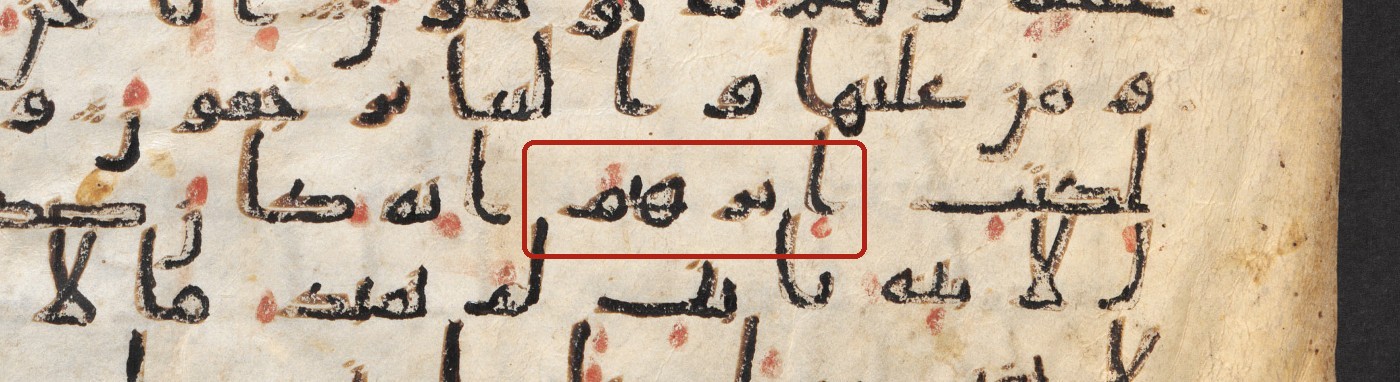
That is the second rung, and it is exactly the shape the hypothesis predicted: a letter the later layers touched, a count that holds on one layer and not another, and the whole dispute resolvable only by reading manuscripts. Appendix D carries the walkthrough in full, together with a disclosure the reader is owed about the order in which the hamza-chair rule was learned, and a reading the chapter offers but does not rest on: that the two yāʾ cases, hidden for a time by marks the later layers added and recovered the moment the skeleton is read as the treatises describe it, may — if the treatise spelling proves to be the archetype’s — be the puzzle’s worked example — the easiest descent in the set, teaching the method on a clean case and pointing toward where the harder cases lie buried.
The ṣād: a letter the reciters moved
The third rung is a letter the page never moved and the mouth did. The Ṣād cluster — the ṣād counted across Surahs 7, 19 and 38, a case the literature named — comes to 153 on the page and 152 in the recitation, and the whole difference is one word: basṭatan at , which the archetype writes with ṣād by the consensus of the codices and the treatises, and which Ḥafṣ, the reader every printed Qur’an follows, recites with sīn, so that the Madinah muṣḥaf prints the ṣād with a small sīn above it to say so. 152 is 19 × 8; 153 is not. The chapter reports both numbers and does not choose between them by their outcome; the reference reading is Ḥafṣ, fixed because it is the reading of the printed Qur’an and not for its arithmetic. Follow Qunbul instead, who recites ṣirāṭ with sīn at five words in these three surahs, and the cluster reads 148. Ṣād on its own at Surah 38 is 29, and does not divide. Inside that surah the letter never moves — 29 in every tradition and on every page, but for the one ṣirāṭ at , which Qunbul’s sīn would take to 28 — so Ṣād alone is the first of the three stable openings that fail. A reading that departs from the written consonant is not an invention of this case — at the archetype writes نجي with one nūn and most readers recite two — and the chapter sets the cluster aside from one calculation below for a different reason: one of the three surahs it spans, Surah 7, is a sign opening by its letters.
The nūn: a stable letter, one short
The second of the three is Nūn, which the literature treated as a question of spelling and the measurement shows to be a stable letter one short. Surah 68 opens “Nūn. By the pen and what they write,” and its nūn count is 132 with the single ن every codex writes, and 133 — 19 × 7 — if the letter’s name is written out, نون, as Rashad Khalifa asserted it is “in the original text”; he cited no codex for it. The early report sometimes offered in support is not a spelling: at Ibn Khālawayh records only vowellings of the spoken name — nūni from Ibn ʿAbbās, Ibn Abī Isḥāq and Abū l-Sammāl, nūna from Saʿīd b. Jubayr — over the single ن (Mukhtaṣar, ed. Bergsträßer, p. 159). Of the two early manuscripts van Putten examined at this opening (van Putten, thread of 8 December 2021), Saray Medina 1a and Wetzstein II 1913, both write the single letter, dotted; neither writes the word out. Nor does the count move anywhere else: it is 132 in every one of the eight reading traditions and in both spellings. Two witnesses are two and not a census, and the surah is thinly attested, so the chapter keeps the case pending as a near miss — one letter short — rather than closing it. A reader weighing the ledger should know how little that carries: a miss falls within one letter of a multiple of 19 about two times in nineteen, no source reports the written form the 133 requires, and the page leans toward failure. The one convention that would supply the missing nūn without a codex, counting the spoken letter-name rather than the written glyph, would have to be applied at every opening, and it breaks the Ḥā-Mīm cluster and K-H-Y-ʿA-Ṣ (Appendix D, Section III).
Ṭā-Hā: the third stable opening that fails
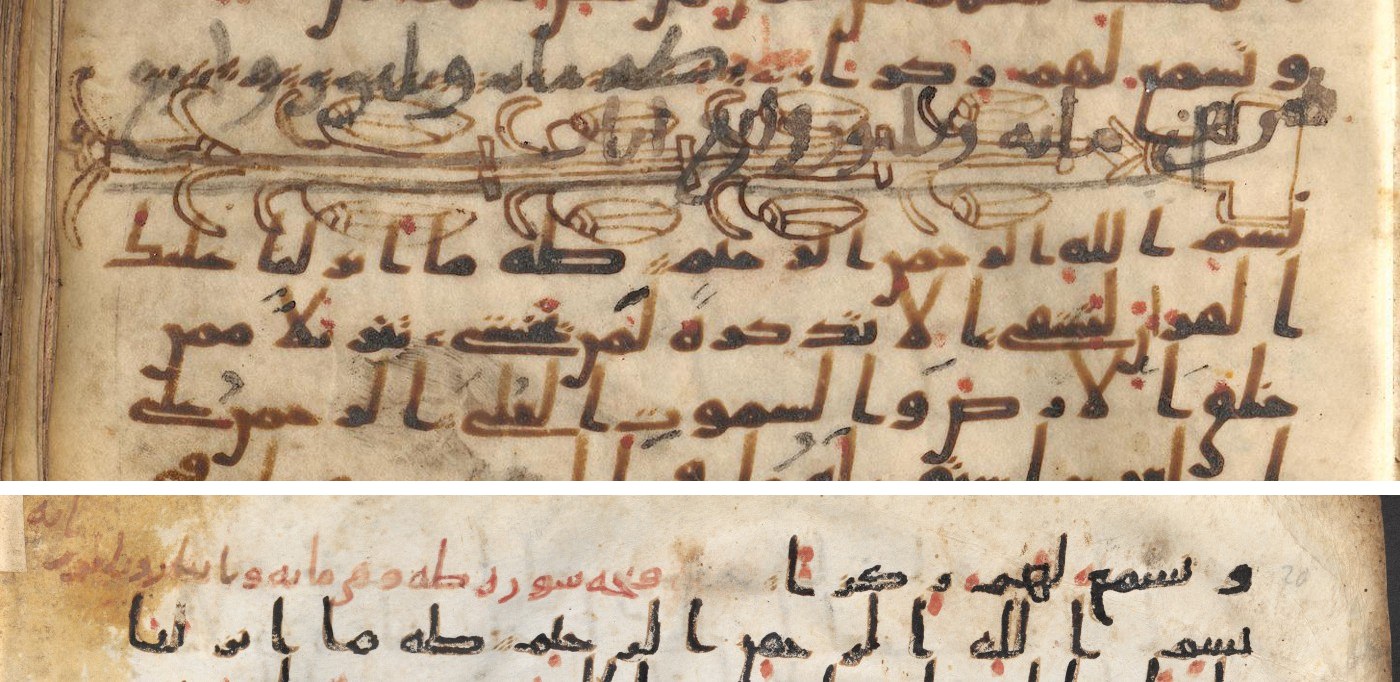
The third belongs on no rung either, and the hypothesis has to meet it as it met the other two. Surah 20 opens Ṭā Hā under a declaration of descent — “We have not sent down the Qur’an to you that you should be distressed” — built from two letters, ṭāʾ and hāʾ, whose written forms never moved. It is not labelled a sign. And it does not divide: 279 with the tāʾ marbūṭa counted as hāʾ, 243 without, not a multiple of nineteen under any convention on the grid. Khalifa never claimed it as a case; what he did was fold its letters into an overlapping set across five surahs and four letters, 1,767 = 19 × 93, which reproduces under the chapter’s rules and is reported for the record but is not a case, because a set assembled after the fact is exactly what the selection warning below is about. So here, beside Ṣād at 38 and Nūn at 68, is the kind of case the chapter said would count against the first prediction: an unlabelled opening on stable letters that fails on every version of the page. Three such openings count against it — three of the six it governs — and the chapter does not hide them.
What the chapter can say is that Ṭā-Hā is also the one opening whose status as letters is genuinely in doubt, and that the doubt is not the chapter’s. A substantial strand of early exegesis — Ibn ʿAbbās, Mujāhid, Saʿīd b. Jubayr, Qatāda, al-Ḥasan and al-Ḍaḥḥāk among those al-Ṭabarī cites — took طه not as letters but as a word, a vocative meaning “O man,” assigned by the reports to the dialect of ʿAkk or to one of several neighbouring languages, which is why Ṭāhā serves as a name of the Prophet. Al-Ṭabarī states it as his own preference, the interpretation “closest to correctness” (Tafsīr, ), and Muhammad Asad opens the surah “O MAN!” on his authority; al-Zamakhsharī records the claim and his doubt of it (al-Kashshāf, ); al-Rāzī rehearses both readings and settles neither (Mafātīḥ al-ghayb, ). The earliest pages do not decide it: in the Birmingham codex, Mingana Islamic Arabic 1572a, folio 1r, consulted in facsimile, the first hand writes the basmala, a verse separator, and then طه in the bare rasm, undotted and unvowelled, running straight on into mā anzalnā with no separator after the two glyphs; Tübingen Ma VI 165 (folio 15r) and Berlin Wetzstein II 1913 (folio 119v) also write طه with nothing between it and the next word, and in Wetzstein a later hand has added fātiḥat sūrat Ṭāhā in red, already treating it as a name. Two letters and a two-letter word are written identically. The recitation tradition, by contrast, says letters: every canonical reader recites the opening as bare letter-names, as it does يس, and the word-reading lives in exegesis alone. If Ṭā-Hā is a word, Surah 20 has no letter-count to fail and leaves the test; if it is letters, it stands with Ṣād at 38 and Nūn at 68 among the unlabelled openings on stable letters that fail. The same caution applies to Yā-Sīn, which the tradition has also read as a vocative, and the chapter will not deploy it selectively — either both are candidate words or neither is. The hypothesis therefore makes the Ṭā-Hā question consequential rather than incidental, and leaves it open: ninety-two manuscripts in the Corpus Coranicum carry , and no one has surveyed how they write it. Appendix D carries the case in full.
Loading…
The Worst Case: The Alif
Now go to the bottom of the ladder, where the hypothesis predicts the check should fail — and the reader should be clear that the prediction is made from the history of the script and not from the count. The alif is the most editorially reworked letter in the history of Arabic writing. The archetype wrote the long ā defectively, without an alif, in thousands of words; copyists inserted alifs for centuries as spelling was modernised; the full and the defective spelling of the same word alternate even within a single early manuscript; the Cairo committee of 1924 chose one spelling for every word on the authority of the treatises; and the early codices disagree with one another and with the treatise reconstruction at dozens of positions in a single surah. No other letter had that history. No other letter had that much freedom. If any letter was going to fail a check on transmission, it was always going to be this one.
Nine of the seventeen historical cases are built on it: the six Alif-Lām-Mīm surahs (2, 3, 29, 30, 31, 32), Alif-Lām-Mīm-Ṣād at 7, Alif-Lām-Mīm-Rāʾ at 13, and the Alif-Lām-Rāʾ cluster (10, 11, 12, 14, 15). At the closest approximation to the source the evidence affords, eight of the nine do not divide by nineteen, and the ninth — Surah 2, at 9,614 = 19 × 506 — divides at a total the literature never claimed. Every one of the nine is a sign chapter — its letter-group is pre-registered as a sign at 10, 12, 13, 15 or 31. None of the nine reproduces its claimed total under the primary convention or under any other: Surah 2, claimed 9,899 against 9,614; Surah 3, 5,662 against 5,495; Surah 29, 1,672 against 1,613; Surah 30, 1,254 against 1,207; Surah 31, 817 against 810; Surah 32, 570 against 558; Surah 7, 5,320 against 5,139; Surah 13, 1,482 against 1,437; the Alif-Lām-Rāʾ cluster, 9,462 against 9,148.
Loading…
And the whole of every gap sits in the one letter. Lām, mīm, rāʾ and ṣād match the claimed totals to the letter in every one of the nine, because they have a single written form that no counting decision can move — this recount’s lām and mīm in Surah 2, 3,202 and 2,195, agree with Khalifa’s figures and with his community’s published tables exactly. The alif does not match, because the claimed totals count as alifs the hamza seats and other marks that the Cairo committee, following the treatises, had already removed from the skeleton, and because the alif inventory of the archetype itself is the one thing no surviving copy settles. Where the yāʾ cases turned on a handful of disputed positions, an alif total in Surah 2 turns on hundreds. That does not make the result unknown; it makes it the least secure tier of the chapter’s evidence, and the chapter reports it as such: on the closest approximation to the source the evidence affords, the claimed alif totals fail. The letter-by-letter accounting, the community’s 2002 recount with its emendations, and the three alif conventions tested side by side are in Appendix D, Section IV.a.
Two things follow. The first is that the controversy has a location. It is not smeared across the alphabet; it is concentrated in the alif, and on the letters that stand still the counts the literature named hold — so the casual reader sees a debunked numerology and the deep reader finds a fault line that follows the physical history of the script. That completes the first prediction of the checksum reading on its other side: the failures among the literature’s cases gathered on the letter whose writing moved most — while the three stable openings that fail, met above, stand as the reminder that a still letter does not by itself make a count divide. The second is that the chapter builds nothing on the nine. They are the historically documented claims of the Code 19 literature, and they fail at the layer the methodology requires; the apparatus for revisiting them exists and waits on one dataset, the alif inventory of the archetype, which critical-edition scholarship is reconstructing word by word. One result on the invariant letters is recorded for the reader and kept out of every figure: lām across its thirteen surahs is 11,799 = 19 × 621, convention-invariant and reproducible, sitting unnoticed in the literature’s own tables because the literature grouped by surah rather than by letter (Appendix D, Section IV.b).
Set the whole ledger beside the history of each letter, then, and it reads as a single line. Of the openings built from letters whose written form never moved, the four cases the literature named hold on every witness, and three openings it argued over or passed by — Ṣād alone, Nūn and Ṭā-Hā — fail. The two on yāʾ, a letter the later marks sat on and the scribes spelled two ways, hold on the treatise spelling and not on the manuscripts, and stand pending until the spelling is settled. The one on ṣād, a letter the reciters move at one word, holds in the mouth and not on the page. And the nine on alif, the letter the writing never stopped revising, fail in every case that depends on it. Four levels, and at each one the hold is more conditional than at the one above. The check passes where the transmission was as good as human transmission can be — at half the openings there, where chance would give one in nineteen — and becomes a question of which layer one reads exactly where the transmission had layers. That is what the ledger would look like if the count were a check on transmission. It is not what the ledger would look like if the count were noise, because noise has no reason to respect the history of the script.
A note on the one text that is not Uthmanic. The lower writing of the Ṣanʿāʾ palimpsest preserves a different recension, catalogued by Sadeghi and Goudarzi (2012); the Corpus Coranicum database carries only its upper text, and the chapter has not audited the eight cases against the lower. Parts of it can be checked in the published tables, and one bears directly on this chapter: folio 22A carries the opening of Surah 19 in the lower text, with K-H-Y-ʿA-Ṣ written as the five letters — the first of the eight cases to have a non-Uthmanic witness at the opening itself, and a check the next recount should run. If the lower text differs at a counted letter, the standing of the affected case would need re-evaluation; if it agrees, the verification reaches further back. The question is open.
The Pattern the Text Said You Would Find
The first prediction was about transmission, and the ledger met it. The second is about the labels, and it is the one the text itself makes. says the number will divide; the text calls the letters at eight openings signs; and the bridge joined the two: what the text calls a sign should divide, and what it calls something else is under no promise. Now lay the ledger against the labels.
The labels are the first pre-registration, set out opening by opening above: the sign form at eight openings, the Book form, the oath form and the descent form at the rest, three openings with no formula at all. Only the sign form is tied by the text to the number and to division; an oath, a declaration or a reference to the Book is a closed claim about the recitation and carries no promise about a count. So the test is not “do the letters divide?” but “do the letters the text calls signs behave differently from the letters it does not?” — and the chapter rests on that one feature, cleanly present or absent at every opening, and not on the taxonomy.
One rule fixes which surahs count as sign chapters, and it comes from the text rather than from the arithmetic. The letters of an opening are the same letters wherever they recur — alif-lām-mīm at Surah 2 is alif-lām-mīm at Surah 31 — so where the text names a letter-group as signs at any opening, it has labelled those letters, and the label travels with them. Three letter-groups are named as signs: alif-lām-mīm (at 31), alif-lām-rāʾ (at 10, 12 and 15, and with a mīm at 13), and ṭāʾ-sīn with or without a mīm (at 26, 27 and 28). Every opening built from them is a sign chapter: 2, 3, 7, 10, 11, 12, 13, 14, 15, 26, 27, 28, 29, 30, 31 and 32 — sixteen of the twenty-nine. The other thirteen — 19, 20, 36, 38, 40 to 46, 50 and 68 — are built from letter-groups the text never names as signs. The grouping is by the whole letter-group, never by a single shared letter, or the rule would mean nothing. And one thing must be said outright: this letter-group rule was articulated after the results of the seventeen were known. Its justification is textual and it meets the standard every rule in the chapter is held to; but it cannot claim to have been fixed before the outcome, so the chapter shows beside it, every time, the narrower rule that counts as signs only the eight openings where the formula is written.
Here is the result, in three findings. First, every opening the text pre-registers as a sign fails at the total claimed for it, and under the primary convention only one, Surah 2, divides by nineteen at all, at 9,614, a total no one claimed. On the letter-group rule, sixteen of sixteen: the nine alif cases the literature claimed are all sign chapters and fail at their claimed totals under every convention, and the three sign openings the literature never claimed — Ṭā-Sīn-Mīm at 26 and 28, Ṭā-Sīn at 27 — carry no alif, were counted anyway, and fail under every convention too. On the formula-only rule, eight of eight. Second, every case on openings the text pre-registers as something other than a sign — an oath, a declaration, the Book — holds where the ledger may count it. Five cases hold as evidence and three are pending. The Ṣād cluster is set aside from this one cell, because it sums across Surah 7, a sign opening, and the three pending cases are given no outcome — Nūn-68, and the two yāʾ cases, which hold on the treatise spelling and wait on the manuscripts. The four that remain, Qāf-50 under an oath and Qāf-42, ʿAyn-Sīn-Qāf and the Ḥā-Mīm cluster under declarations, all hold: four of four. Count the two pending yāʾ cases as holds, which the manuscripts do not yet allow, and it is six of six, Yā-Sīn under an oath and K-H-Y-ʿA-Ṣ under no formula (Fisher, about 1 in 5,000); on the hard tier it is four of four (about 1 in 715). Third, the converse was never promised and does not hold: Ṭā-Hā, unlabelled, fails, and the chapter has said what it makes of that. One sentence a hostile reader cannot get wrong: there are twenty-nine openings; sixteen are sign openings by the letter-group rule, and none of the sixteen holds at its claimed total — one, Surah 2, divides at 9,614 under the primary convention, a total no one claimed; the cases that hold are aggregates the literature named, none of which is one of the sixteen.
The cleanest way to see what the label is doing is a pair of openings that differ in almost nothing else. Surah 12 opens alif-lām-rāʾ, tilka āyātu l-kitābi l-mubīn, innā anzalnāhu qurʾānan ʿarabiyyan laʿallakum taʿqilūn — “These are the signs of the manifest Book. We sent it down as an Arabic Qur’an, that you may understand.” Surah 43 opens ḥā-mīm, wa-l-kitābi l-mubīn, innā jaʿalnāhu qurʾānan ʿarabiyyan laʿallakum taʿqilūn — “By the manifest Book. We made it an Arabic Qur’an, that you may understand.” The same phrase, the same closing clause, word for word; 12 names its letters signs where 43 swears by the Book. Surah 12 fails at its claimed total. Surah 43 sits inside the strongest case in the book. The pair does not prove the mechanism — the letters differ too — but it shows which feature the pattern is tracking, with nearly everything else held fixed.
And now the two predictions meet, and the reader should see exactly how. The letter-groups the text calls signs are, without exception, the ones that carry the alif — alif-lām-mīm, alif-lām-rāʾ, alif-lām-mīm-rāʾ — the one letter whose written form the manuscript tradition would never be able to fix to the stroke. In other words the text put the word sign on exactly the openings where the check would be hardest to run and the count hardest to settle, and said of signs that they divide. The reader can suspect, and should, that “the signs fail” is only “the alif fails” wearing a label: the alif is the commonest letter in Arabic, and any set of labels would have caught it somewhere. Three openings decide that suspicion. Ṭā-Sīn-Mīm at 26 and 28 and Ṭā-Sīn at 27 are named signs and carry no alif — their letters are among the stable ones — and they fail. Stability does not predict that; the label does. So the two predictions are not one prediction twice: the transmission predicts where the count becomes uncertain, and the label predicts where it fails, and at three openings the label does work the transmission cannot explain. What the data cannot do, and the chapter says so, is separate the two completely: because sign chapters are grouped by their letters, no letter-group appears both in a sign chapter that fails and in a non-sign chapter that holds, so the sign partition and the letter partition are one partition on the alif cases, and only the three ṭāʾ-sīn openings and Ṭā-Hā pull them apart. Appendix D sets out the confound and the numbers (III.b, V.D).
Whether the alignment is design or coincidence has a price, and the price depends on which rule for “sign” the reader accepts, so the chapter states both. On the letter-group rule, with the Ṣād cluster and the three pending cases set aside: no sign case among the four that hold, all nine sign cases among the failures — about 1 in 715 by Fisher’s exact test on the thirteen that remain, and about 1 in 360 with the three alif-free openings added (Ṭā-Sīn-Mīm and Ṭā-Sīn as sign failures, Ṭā-Hā as a non-sign failure); with the yāʾ pair given the benefit of the doubt, about 1 in 5,000 and 1 in 2,650 (Appendix D, Section V.D, where the tables are set out). On the formula-only rule: about 1 in 3, or 1 in 5 with the benefit of the doubt. The clean result belongs to the wider rule, and the reader who declines that rule is left with a pattern in the predicted direction that chance could produce one time in three to five. Every one of these figures conditions on the seventeen cases the literature chose; what happens when nothing is chosen is the subject of the next section.
The chapter attaches to this reading the cost that keeps it honest, and it is the same cost either way. If the alif inventory of the archetype is ever completed and the alif cases fail on it, the checksum reading is wounded, because a check that fails at the source is no check — what would survive is the division of readers, which promises and no count can end. If they divide on it, the sign reading is wounded, because the signs would then not have divided after all — and Khalifa’s totals would have been right on a text nobody else could see. The audit reproduces his totals exactly wherever a letter the record settles can be counted, and locates every failure in the one letter the record does not; that is the shape a wrong list would have if its errors all fell on the hardest letter, and also the shape a right list would have if it had been counted against an inventory no surviving copy carries. The two stories are distinguishable, the alif inventory is what distinguishes them, and the chapter does not know which is true. It knows the question has an answer, that the answer lies in libraries, and that the text predicted a division over this number fourteen centuries before the division happened.
What would falsify the reading, stated concretely. An independently reconstructed alif inventory of the archetype, counted under rules fixed before the recount, on which the sign chapters hold as readily as the others or the others fail as readily as the signs — with the caveat that the full and defective writing of ā alternates even within a single manuscript, so the inventory may return a distribution rather than a verdict, and the chapter would then report the sign cases as failing or holding with a probability. Any letter-group found both in a failing sign chapter and in a holding non-sign chapter. And a pattern-discovery control that produces the frozen structure described next at a comparable rate. Any of the three ends the arithmetic claim as the chapter states it.
What Chance Says
The standard defence against a numerical-pattern claim is to show the pattern is unlikely against similar texts, and the chapter has run that control rather than talked about it. But the figures have to be ranked correctly, because the literature’s mistake was in the ranking. The binomial figures first, at their proper size: over the three independent trials the cases that hold on every witness yield — Qāf-50; ʿAyn-Sīn-Qāf with Qāf-42 folded in, since they share a qāf; the Ḥā-Mīm cluster as one trial — the joint probability under a null calibrated to the Qur’an’s actual letter frequencies is about 1.2 × 10⁻⁴, or 1 in 8,000; with the two pending yāʾ cases given the benefit of the doubt as two more trials, about 3.5 × 10⁻⁷, or 1 in 2.9 million. Those numbers describe how unusual these particular counts are under a stated null. They do not describe how hard such counts are to find, and that is the question that matters, because the historical investigator chose his cases while he counted. A search with the freedom to group surahs, pool a letter, drop the basmala, pick a convention and admit a variant is rolling the dice many times, and Appendix D, Section V.E, measures exactly how many. It gives a simulated investigator those freedoms one at a time and runs him on Ṣaḥīḥ al-Bukhārī, Ṣaḥīḥ Muslim, the Sīra of Ibn Hishām, pre-Islamic poetry, and the Qur’an with its openings dealt at random. With the historical freedoms restored, the search finds as many multiples of nineteen on Bukhārī as on the Qur’an, roughly half the time. The count of holds is not the evidence. Every freedom is another roll, and enough rolls produce multiples on their own. Be exact about what that makes ordinary: not the Qur’an, whose text the control never touched, but the investigator.
The question begins where the choices end, and that is where the chapter’s headline sits. Freeze the frame: every one of the twenty-nine openings a case, identical openings grouped by a rule fixed before the run, nothing set aside, no letter pooled, no convention chosen after looking. Fourteen cases result. Three hold on every witness — Qāf-50, ʿAyn-Sīn-Qāf and the Ḥā-Mīm cluster — and two more, Yā-Sīn and K-H-Y-ʿA-Ṣ, hold on the treatise spelling of the yāʾ and are pending on the manuscripts. Counted strictly, the frame reads three of fourteen, about 1 in 29 under the analytic null, none of the three a sign opening, with the alignment about 1 in 6.5 on the letter-group rule and 1 in 4 on the formula-only rule. Give the pending pair the benefit of the doubt and it reads five of fourteen, about 1 in 1,850, none of the five a sign opening, with the alignment about 1 in 36 and 1 in 16. Run the same frozen frame on the five control corpora and five holds are matched 5, 5, 6, 3 and 7 times in ten thousand runs, and the whole configuration — five of fourteen with none a sign opening — in none of ten thousand on any corpus, which bounds its rate at no more than about 3 in 10,000, since zero events in ten thousand trials licenses only that much; three holds lie above the ninety-fifth percentile of every control corpus, which is as finely as the published runs resolve it. The chapter leads with the strict figure, states the other beside it, and calls neither a prediction: the rules of the frame were fixed after the historical cases were known, and Appendix D says so. These are modest numbers, because fourteen cases cannot give large ones, and they are the chapter’s headline precisely because they are the figures with the least remaining freedom. Not no freedom: the analyst still chose divisibility, the rule that groups identical openings, the primary convention and the treatment of the basmala, and chose them knowing the historical results. What the frozen frame removes is selection after the run — no case set aside, no letter pooled, no convention switched once the numbers are seen — and that is the freedom the historical search used most. The pattern is visible at the rung where that freedom is gone, and it fades as the investigator begins to choose for himself. The frozen frame also drops the seventeen-case list the literature chose, exposes what the Ṣād cluster hides, and shows that the three single-letter openings, the easiest counts in the book to tune, hold once in three.
Loading…
Three quantities, then, and they are kept apart and never multiplied: the rarity of the counts, the alignment of the holds with the labels, and the discovery-adjusted surprise — how often a free search finds something this impressive anywhere. They address different aspects of the chance hypothesis and are not independent enough to multiply. The conclusion they support is conditional in the right way: for the cases that hold at the best approximation to the source, the observed pattern is unusual under the null models tested, and under the frozen rules it is unusual against matched control corpora as well; under the freedoms of the historical search it is not unusual at all. Every figure, its calibration, the Monte Carlo validations and the six-trial sensitivity that puts the Ṣād cluster back are in Appendix D, Section V, and the full probability discussion that earlier stood in this chapter is preserved there.
Why a Proof Would Divide Anyway
An objection presents itself and deserves a direct answer. The Qur’an says in dozens of places that it has given clear proofs — āyāt bayyināt. How can the same book promise clear proof and then, at , design a sign whose stated purpose is to divide? The answer begins in the grammar of the clarity verses. The text almost never says “clear proofs” flat; it says clear for someone — for people who reflect, who reason, who have certainty — and the same verses that announce clarity report in the same breath that people reject it anyway (). The Qur’an never claims proof that compels every observer, and declines it as a design choice: “If We willed, We could send down from heaven a sign so their necks would bow to it” () — could, and does not; “will you then compel people to be believers?” (). A sign, on the text’s own account, is an instrument whose output depends on the state of its receiver: the same recitation is healing for one audience and loss for another (), the same parable guides many and misleads many (). is not a retreat from the clarity verses. It is their mechanism, stated for one specific sign.
The nearest familiar analogy is a mathematical proof: decisive, and yet it divides every room it enters, into those who work through it and those who wave it off, and no one thinks the division impeaches the clarity. What “clear” rules out is vagueness. What it does not rule out, and on the text’s account deliberately preserves, is resistibility. That places a requirement on the sign itself, and paints the portrait: the rejecter is not a man staring down an undeniable wall and blinding himself, but a man with a shrug — “what does God intend by this as an example?” A sign that can be dismissed with a shrug and can simultaneously produce certainty in the one who examines it cannot be monolithic. Only a layered sign — a core that survives every examination, a periphery that offers the casual reader his exit — does both jobs through ordinary epistemic behaviour, which is what a trial requires. The chapter does not claim predicted this shape; it predicted divided reception, and a two-layer shape is one shape consistent with that, and the one the audit found. The structural weight stays with the tables and the controls. What is offered here is only that the shape found does not contradict the reading — and two caveats stand beside even that: any messy evidence base has a solid core and a contested edge, and the reading must never curdle into “your doubt proves your heart is diseased.” Assent is available to examination; dissent is not diagnostic.
The text narrates the case that proves the alternative would have failed. Iblīs is the limit case of evidence: no inference, no transmission chain, no count — direct presence, direct address, a command from the source. He does not doubt the power he defies; he asks it for a reprieve until the Day of Resurrection (), which presupposes total certainty about both the power and the judgment. What he withholds is the one thing evidence cannot supply, trust that the Judge is right, and he refuses on an argument — “I am better than him” (, ) — which is pride, not ignorance. The first division in the Qur’an’s cosmology takes place under overwhelming evidence. The lesson is precise: rejection is not an information problem, so information was never going to be the remedy. A maximal sign does not repair the will; it only strips the rejecter of his respectable exit. Once that is seen, a dividing sign stops looking like a concession and starts looking like the only instrument fit for purpose, and the next chapter examines the figure of Iblīs at length. The full form of this argument, with its verses, is preserved in Appendix D.
What the Puzzle Leaves
Set the cases on the measurement of the layers, and the shape of what is left is plain. The holds that survive every witness stand on the stillest letters the text has. The pending cases stand on the yāʾ, which the later marks sat on, and the failures the literature argued over stand on the alif, which no two layers write alike. Three openings on still letters fail as well, and two of them, Ṣād and Nūn, are single-letter openings; the only other single-letter opening, Qāf, holds alone, inside ʿAyn-Sīn-Qāf, and summed across both. The one case that turns on whether the page or the mouth is counted turns on one word, basṭatan at , written with ṣād and recited by Ḥafṣ with sīn — in the text this chapter counts, the only word inside any counted case that the page writes one way and the reading says another — and a regrouping of the openings tested after the fact, reported in Appendix D, Section III.a, finds the same word deciding between two whole systems of totals. And the last of the openings, Nūn — the only letter that appears in a single opening and stands in it alone — opens under an oath by the pen and what they write, and is one written letter short, on a count that does not move in any tradition.
A reader may see in this the division describes, built into the text at the place where writing and recitation part: in the traditional order of revelation the first surah names the pen () and the second swears by it (), and the pen — the written layer — is the part of the transmission that moved. A sceptic may see the places where a pattern runs out. The evidence does not choose between them, and the chapter will not choose for it. It can say only where the choice would be made: in an early codex at that writes the name out, which no source yet reports, and in the alif inventory of the archetype. Those are questions for the manuscripts, not for the arithmetic.
The Next Questions
A puzzle looks right once you see the solution clearly, and slightly off until you do. This one is still off in places, and the places are known; they are the reader’s, and they are all questions of philology. The first is the alif inventory of the archetype, which critical-edition scholarship is reconstructing word by word, and on which the whole sign side of the ledger waits; the chapter has said which way each story goes when it arrives. The second is the lower text of the Ṣanʿāʾ palimpsest, which no one has counted at these openings though one of them is written out on a leaf that survives. The third is Ṭā-Hā: two letters, or a word — and ninety-two manuscripts no one has surveyed. The fourth is Nūn: whether any early codex writes the name out, which no source now reports. The fifth is the sister tests the literature has proposed beyond the openings — the thirty distinct integers the text names, the occurrences of “this Qur’an” and of al-Raḥmān, the letters of the first revelation — none of which enters this chapter’s figures, each of which would need its targets and its operation written down before the count, and all of which are set out with that requirement in Appendix D, Section VIII. And then the larger question the text itself invites at : if the openings carry a count, could the whole text carry one, a structure beneath the surface of which the letter-counts are only the visible edge? The chapter does not claim that there is. It records that the text invites the question, and that each probe of it must be anchored as carefully as the openings were, or not run at all.
And here the chapter turns the puzzle over, because it was never the chapter’s to keep. The text asked the question itself — what does God mean by this? — and wrote it down as the words of the audience it expected; it placed its signs in the text and said at that hearing, sight and fuʾād would answer for what the reader pursued. That is an invitation to examine, not to believe, and it is addressed in the singular. The pieces are on the table: the codices, the treatises, the readers, the counts, the controls, and the questions just named. Nobody solves this from the sofa. The reader who wants a solution will have to do what this chapter did and do it better — go into the history of the writing, into the philology of a letter, into the readings, and audit every step for the freedom hiding in it. The puzzle rewards exactly that reader, and the text says so.
Two Conclusions
Step back from the count and look at what the history has shown. The writing of the Qur’an was revised, repeatedly, though the revision was one of regularisation rather than invention: dots made consistent, vowel signs added, the long ā written out by degrees, and the consonantal skeleton itself left standing. The recitation was preserved with extraordinary care, teacher to student across fourteen centuries, through ten canonical readings traceable by named chains to the first and second centuries — and it, too, was in places normalised, as van Putten has shown at , where a reading reported by seven independent sources was eliminated from living practice because grammarians judged it incorrect. The oral channel preserved, and it also filtered, toward grammatical taste. The skeleton was not free to be normalised that way. That is why the count is anchored in the rasm, and the full history is preserved in Appendix D.
Against that history the count produces exactly the pattern a check on transmission would produce. The cases that hold are the cases on the letters the transmission never touched — though not every opening on those letters holds, and the chapter has named the three that do not. Four of them count the same on every page from the earliest fragments to the digital encodings; the two on yāʾ do not — their totals move when a later mark is allowed to override the skeleton, and at five positions the manuscripts and the treatises spell the letter differently — and they stand pending. If the treatise spelling is the archetype’s, the archetype’s total can be recovered through every layer, and reappears the moment the skeleton is read as written. That is the precise claim, and it is conditional: not that the number sat unchanged on every page, but that, on that spelling, the source’s number can be read back through everything laid over it. The cases that fail are the cases on the letter the transmission never stopped touching. The text named that letter’s openings as signs, said signs would divide, and wrote down the question the divided would ask. From this, two conclusions are available, and the reader must weigh both.
The chapter’s judgment — a judgment, not a computation. Having considered the human story below and the confounds the evidence leaves unresolved, the chapter judges intentional design the more likely explanation; nothing in the probabilities entails that judgment, and the reader should hear it as the author’s posterior, reached after the ledger and not read off it. On this reading the text knew its letters would be examined and knew which would come down secure and which would not; over the secure letters it placed oaths and declarations, closed claims about the recitation, and over the insecure letter it placed the word sign, and said what the number would do with its signs. What it set was a puzzle, and it said so, and a puzzle is not a proof and was not meant to be one. The record, read fourteen centuries on, falls the way the text said: the cases on the secure letters hold, four of them on codices and treatises alike; the cases on the insecure letter fail at their claimed totals and divide their readers; the three sign openings on stable letters fail as well. The figure this reading rests on is the frozen frame, because it is the figure with the least remaining freedom, and the reading carries the fork already stated: whichever way the alif goes, the cases on the secure letters do not move — they are lens-invariant, in the sense the book gave that word at the start — but the sign story survives on only one branch, and the chapter would say so.
The alternative — a serious human story, told as one. A formidable reciter in seventh-century Arabia produced a text of extraordinary formal density, rhymed and formulaic, so that letter frequencies in a surah are anything but random draws. Its skeleton was fixed early and copied with unusual fidelity, so that a handful of letters with a single written form count the same on every page ever made; its long ā was written defectively and then normalised for centuries, so that the alif never counts the same twice. A twentieth-century researcher counted the letters of the openings, found multiples of nineteen where the stable letters happened to give them, drew up a list of seventeen and re-theorised the misses; his community later repaired the text to keep the list whole. A twenty-first-century audit kept what survived the rasm, found that it was exactly the stable letters, and found that the openings which call their letters signs happen — by a rule the audit itself argues for — to be the ones spelled with the unstable letter. On this story the labels track letter-class by accident of spelling, the pattern is real and explained by orthography and selection, and is a verse about the wardens of the Fire. Three facts give this story its footing: the alif is the commonest letter in the language, so any letter-group containing it was always going to be the least countable, foresight or no; on the alif cases the sign partition and the letter partition are one partition; and the stable letters do not pass everywhere — three of the six unlabelled openings built wholly from them fail. What the story has to carry on its own is smaller than the inventory the other story is tempted to pile on it, and the chapter will not pile: the four cases every kind of evidence supports, at about 1 in 8,000; three sign openings on stable letters that fail; a frozen frame no free search reproduces; and the fact that the text wrote down the division, and the question of the divided, before anyone counted.
The chapter states its judgment and does not pretend the arithmetic compels it; the story it finds less likely is one a reasonable person can hold. What it does claim is that the evidence is now sharp enough to force the weighing. Until this audit, the unsettled claims could be dismissed as methodological artefacts and the ones that held as cherry-picked. The first dismissal no longer stands; the second stands against the historical list as a list and fails against the frozen frame, where nothing was picked. The reader is left with the choice names.
What You Can Verify
The command at is addressed to you in the singular, and on the chapter’s reading of it — the application stated at the outset, and open to disagreement — a claim that can be checked should not be accepted until you have checked it yourself. The chapter has tried to honour that by reporting everything it can — the cases that hold, with their tiers; the cases that fail, with their gaps; the rules, the grid, the probabilities and the controls, and the comparison to the most careful work in the literature. The reader can audit all of it. But the chapter cannot do the verification for the reader; on its own reading of , that would miss the point of the verse. What follows is the invitation.
If you read Arabic, the verification is direct. Open a Qur’an. Turn to Surah Qāf, the fiftieth, whose entire opening is a single named letter. Recite it from beginning to end, and count every time your tongue produces the consonant q. The number will be 57. Divide by 19; the remainder is zero. Turn to Surah 42 and do the same: 57 again, and the two add to 114, the number of surahs in the Book you are testing. In Surah 42 count three letters together, every ʿayn, every sīn and every qāf, basmala included: 209, and the remainder is zero. Turn to Surah 40 and count every ḥāʾ and every mīm, basmala included; then 41, 42, 43, 44, 45, 46; add the seven totals: 2,147, and the remainder is zero. These four reproduce as multiples of nineteen against any printed Qur’an under any counting convention whatever.
Turn to Surah 36. Count every sīn, and count every yāʾ as the page writes it — the letter ي, the letter ى, and the yāʾ-shaped chair beneath a hamza, four of them in this surah — because that chair is what the earliest manuscripts wrote; do not count the small superscript yāʾ, which is a recitation mark added centuries later. Basmala included: 285, remainder zero. Turn to Surah 19. Count every kāf, ʿayn, ṣād and yāʾ by the same rule, and every hāʾ, counting the tāʾ marbūṭa as a hāʾ because in the earliest manuscripts the two are one letter: 798, remainder zero. These two reproduce under the rules just stated — the rules that read the page as the earliest manuscripts wrote it — and a reader who counts the hamza sign as cancelling the yāʾ beneath it, or the two dots as cancelling the hāʾ, will get 281 and 792 instead, and should understand that in doing so he has counted a mark added centuries after the recitation. He should also know, because the chapter has told him, that at three words in these two surahs the surviving manuscripts spell the yāʾ differently from the printed page, and that on their spelling the totals are 287 and 795 — which is why the chapter holds both cases pending.
The Ṣād cluster reproduces in exactly the way this section asks for: recite Surahs 7, 19 and 38 as Ḥafṣ recites them and count every ṣād your tongue produces, saying basṭatan with a sīn at as the reading requires, and the total is 152; count the printed page instead, where the archetype writes that word with ṣād, and it is 153. The Nūn-68 count of 133 requires a spelled-out نون that no codex is known to write, and the reader should treat it as pending. The longer counts the literature has defended — the alif cases — are the reader’s to attempt, with the knowledge that under the modern text they come to numbers near the claimed totals and not equal to them, and that the whole of the distance sits in one letter whose form at the source no one can yet fix. None of the six counts above comes from an opening the text pre-registers as a sign. They are the cases made no promise about — and they hold.
If you cannot read Arabic, the verification is indirect but not less available. There are ḥuffāẓ — memorisers — in nearly every Muslim community on earth. Ask one of them to recite Surah Qāf for you. Listen for the q sounds. Tally as you hear them. Confirm 57. The Qur’an is a recited text; it exists, in the most direct sense, in the mouths of those who have memorised it, and every reciter in every mosque is performing the source layer against which the chapter has performed the count. Recite. Listen. Use the hearing, the sight and the fuʾād you were given.
The Paradox of Choice
What the chapter has shown, under the bridge it stated at the outset, is this. The count is a check on transmission, and it reads as one: it passes on the letters the transmission never touched, on every page ever written — not at every opening built from them, but at half, where chance would give one in nineteen; it becomes a question of which layer one reads on the letters the transmission touched; and it fails on the letter the transmission never stopped touching. The text labelled that letter’s openings as signs, said signs would divide, and wrote down the question the divided would ask; and three openings on stable letters that it also labelled signs fail too, which is the label doing work the transmission cannot. The alignment is not the chapter’s construction. The labels are features of the text, catalogued a millennium before any count; the prediction that the number divides was made by the text at ; and the link between the two is the chapter’s, stated as a reading. The figures that can be priced are priced in Appendix D and never multiplied; the one that survives its own control points the same way as the rest, at a size the reader can see.
And here is the sentence the chapter has been working toward. The same data — the same counts, the same arithmetic, the same recitation from the same source — is not a proof. A proof is a judgment, and the judgment is the reader’s. What the data is, is a puzzle partially complete, and predicts that the incompleteness will be read two ways. Some readers will look at the pieces that have gone together and the places where they have not, and take the challenge itself — “what does God mean by this as an example?” — as the answer: the pattern is where He said it would be, the gaps are where He said they would be, and that is enough to trust. Others will look at the same pieces and see a curiosity. Both are responses to a puzzle that is not finished; neither is a failure of the chapter or of the evidence; and the divergence is at least consistent with the reception the verse predicts.
This is unusual. Most arguments for the divine origin of a text are built to leave the reader no defensible alternative. The Qur’an’s argument at –31, if the chapter’s reading of it is right, is built differently: the puzzle is set, the number is named, the two readings are predicted in advance, and the thing is designed not to compel but to divide, and to complete its work whichever response it produces. Whether this particular puzzle is what the verse intended remains the interpretive question the chapter has carried from its first page; what follows is what the design would mean if it is. Why would the strongest evidence a text offers come as a puzzle rather than a proof? Because a puzzle is the one form of evidence that cannot be received passively. It does not force you to use your mind; it requires it, if you want a solution — and leaves you free to want one or not. The first seventeen chapters set statements beside how the world has turned out to work, and a correspondence can be read to you. A puzzle cannot. It says: now you think, you read, you investigate — solve this, or don’t. You are not a robot. You are a creature with a God-given intelligence, and the text has arranged its strongest evidence so that the intelligence has to be used, by your own choice, before the evidence can be evidence at all.
A reader will ask the obvious question: if the puzzle is not meant to be solved, why set it? But that is not what the chapter has said. The puzzle is meant to be solved. It is not meant to be solved for you. A proof ends the matter for everyone who follows it; a trial must be passable and failable by the same evidence, so the form had to be one that yields to work and not to a glance. If the answer lay on the surface there would be no trial; if it lay out of reach there would be no certainty to attain. A puzzle is the only form that does both — and it does something a proof cannot: it makes the solution the solver’s own. The controls of Appendix D added something to this the chapter did not expect. The puzzle turned out to be solvable exactly to the degree that the solver lets the text make the choices — visible where the text fixes the cases and the rules are frozen, fading as the investigator begins to choose for himself, which is what the literature did for forty years. A puzzle whose solution is how to read it is one built so that solving it changes the solver.
So the puzzle stands open, and the chapter leaves it open on purpose. A reader who wants the shape of it in one image can have the one the text supplied: calls the number an example set before the puzzled, and the puzzled are quoted turning it over. Take it as the cube it resembles — six faces, coloured, scrambled, and no instructions. Three faces have come up solid. The check passes on the letters that never moved, four cases on every witness, one as recited, and three pending — two on the spelling of the yāʾ, one on a spelled-out nūn. The partition holds in the direction that matters: not one opening the text calls a sign holds, and the failures on the other side — Ṭā-Hā, Ṣād on its own, Nūn as written — are named, not hidden. And the placement holds under a frozen frame that a free search cannot reproduce. Three faces are still scrambled, and the chapter can say exactly which and why: the alif cases, which wait on an inventory of the archetype no one has completed; the lower text of the Ṣanʿāʾ palimpsest, which no one has counted at these openings; and the sister tests, which no one has enumerated. Anyone who has held a cube knows the next part. You cannot finish the last faces by forcing them; a move that fixes one square and breaks three is not progress, and the Code 19 literature spent forty years making that move. The last faces come from more data, applied under the same rules that solved the first three — and the data is out there, in libraries, waiting to be read. Which names the tool. The tool that will fully solve the mysterious letters is not arithmetic; the arithmetic was finished in an afternoon. It is academic philology — the reconstruction of what the text was before it was edited, letter by letter, from the manuscripts and the treatises that describe them — because every one of the three scrambled faces is a philological question and not a numerical one. What did the archetype write at the alif positions? What did the Ṣanʿāʾ scribe write beneath the text that replaced him? What is the full set of letters the openings could have used, and did not? No count answers those. Only reading does — the reading the historians do, with a vote in the evidence and none in the conclusion. The command that opens the book turns out to be the last instruction the puzzle needs.
Two objections wait at this point, and the chapter should meet them before it hands the question on. The first: a puzzle three faces short of solved after fourteen centuries looks like a puzzle no one was meant to solve. But if the text is serious — and reads as nothing if not serious — it would not set a challenge that cannot be met; a trial that no one can pass divides no one, and dividing is the one thing the verse says the number will do. What a serious challenge may do is wait on tools its first readers did not have. The faces that came up solid came up by way of instruments mankind built in the meantime: the statistics of the frozen frame, ten thousand control runs, the stemmatics that reconstruct an archetype from fourteen manuscripts, the radiocarbon that dates a page, and — this book is, after all, what it says it is — a machine that can hold the whole text in view at once and count without tiring or hoping. A puzzle that opens to such tools, and only to them, is not an impossible one. It is one set for a reader who would one day build them, which is the reading of iqraʾ this book has argued from its first chapter. And consider the span. This is a puzzle that has been running for fourteen hundred years — longer than any nation, any institution, almost any written language has kept the same shape. A text that expects to be read for that long does not need its puzzle solved in the first generation. It needs it to stay unsolved for exactly as long as it takes its readers to grow into it — to invent the manuscript science, the statistics and the machines — and then to open. A puzzle that opened in the seventh century would have been a puzzle for the seventh century. One that holds for fourteen centuries and begins to open now is a puzzle built to the size of the claim: a book for all people and all time. The duration is not a defect of the design. It is the design. The second objection is older and sharper: why not simply say it? If the author could make the pattern perfectly plain — nineteen at every opening, no alif cases, no bridge — why leave three faces scrambled and a plank or two to the solver? The chapter has an answer, and it is not a shrug about mystery: there is a reason a being who could compel assent would choose not to, and the reason is the subject of the next chapter.
One more thing should be said about what a puzzle is, because it bears on what the chapter has and has not shown. A puzzle is evidence of intent. A pattern by itself is not: patterns fall out of randomness all the time, and a chemistry that happened to land on a self-copying molecule and so started evolution is a pattern with no one behind it. But a puzzle is a pattern that has been declared, with its pieces named and its clues laid where a solver will find them and its reception predicted — and that is not what randomness produces. It is what purpose produces. So the finding of this chapter, before any question of who, is that the mysterious letters are not noise the tradition has been politely stepping around for fourteen centuries. They look like the work of a mind that meant something by them, said so, and left the work to be done. Is that evidence of God? Here the chapter must be exact. Intent is what the evidence shows; whose intent is a further step, and it is not one that evidence can take. No one can prove God — not a prophet, not a scholar, not a machine, not even the adversary of the text’s own account, who is said to have stood in the presence and still could not hand the proof to anyone else — because to prove God you would have to be God. A proof of that kind would have to stand outside everything and vouch for it, and nothing inside can do that. The very last step, then, cannot be a proof. It has to be trust and belief: trust that the one who set the puzzle is who the text says set it, and belief that follows from the trust rather than from a demonstration. The puzzle can carry a reader to the edge of that step, and the chapter has argued that it carries a reader further than any other evidence in this book. It cannot take the step for them. The text, as it happens, says the same: it calls the people it addresses those who believe, not those who have been shown.
So the chapter ends with the question it has been working toward, and hands it to the next: why a being who could compel would choose, instead, to be trusted. The Robot receives it.
The Claim in Brief
The same five questions close every evidence chapter, so the claims can be compared on the same terms. Scores and verdicts are deliberately left out.
| What does the text say? | says “over it are nineteen” and calls the number a trial that will bring certainty to some and dismissal to others; at eight of the twenty-nine lettered openings the next words call the letters signs (tilka āyātu l-kitāb), and the text says God has counted all things (). The verse does not say what the nineteen is over: that it governs the opening letters, that the operation is divisibility of their counts, and that the signs are where the number divides are the analyst’s inferences, and the classical reports tie to the wardens of the Fire. |
|---|---|
| What would we expect historically? | The consonantal skeleton of about 650 CE wrote some letters in only one form and the long ā defectively, and was copied with unusual fidelity before dots, vowels and hamza signs were added in later layers. The chapter’s own human alternative has a formidable seventh-century reciter producing a rhymed, formulaic text whose letter frequencies are far from random; the earliest recorded attempt to read the letters was already numerical. |
| What is the strongest supporting evidence? | Four cases on stable letters hold under all ten counting conventions and on first-century codices and medieval treatises alike — Qāf-50 and Qāf-42 (57 each), ʿAyn-Sīn-Qāf (209), the Ḥā-Mīm cluster (2,147) — about 1 in 8,000 under a calibrated null, none at an opening called a sign, while every sign opening fails. In the frozen frame of fourteen cases, under rules fixed before the run but written after the historical counts were known, three of fourteen hold counted strictly (about 1 in 29); five hold only if the two pending yāʾ cases are counted (about 1 in 1,850), and that configuration appeared in none of ten thousand runs on five control corpora, bounding its rate at no more than about 3 in 10,000. |
| What is the strongest objection? | Given back the freedoms the historical search used, a simulated investigator finds as many multiples of nineteen in Ṣaḥīḥ al-Bukhārī as in the Qur’an, roughly half the time. On the alif cases the sign split and the letter split are the same split; three of the six unlabelled openings built only from stable letters (Ṭā-Hā, Ṣād-38, Nūn-68) fail; and the letter-group rule defining sign chapters was articulated after the results were known, while the formula-only rule leaves an alignment chance could produce one time in three to five. |
| What remains unresolved? | The nine alif cases wait on an alif inventory of the archetype that no surviving copy settles — if they fail, the checksum reading is wounded; if they divide, the sign reading is. The yāʾ cases and Nūn-68 stay pending, and the analyst chose divisibility, the grouping rule, the convention and the basmala treatment knowing the historical results. The chapter’s preference for intentional design is a judgment, not a computation, and it calls the human story one a reasonable person can hold. |