Introduction
On September 13, 1848, a twenty-five-year-old railroad foreman named Phineas Gage survived one of the most extraordinary injuries in medical history. While tamping gunpowder into a rock near Cavendish, Vermont, an accidental explosion drove a thirteen-pound iron rod through his skull, entering below his left cheekbone, passing behind his left eye, and exiting through the top of his head. He remained conscious, speaking within minutes. His sensory and motor functions—vision, hearing, speech, movement—were largely intact. Yet something essential had changed.
Dr. John Martyn Harlow, who treated Gage over the following months, documented a striking alteration in personality. Before the accident, Gage had been described by his employers as “the most efficient and capable foreman in their employ,” a man of “temperate habits” and “considerable energy of character” (Harlow, 1868). After the injury, Harlow recorded that Gage had become “fitful, irreverent, indulging at times in the grossest profanity (which was not previously his custom), manifesting but little deference for his fellows, impatient of restraint or advice when it conflicts with his desires” (Harlow, 1868). His employers, who had previously considered him a great favorite, could not give him his position back.
The case has become foundational in neuroscience for a simple but profound reason: it demonstrated that the frontal region of the brain—the area behind the forehead—is critical to moral judgment, impulse control, and the integration of emotion with reason. Gage’s hearing and vision were intact, but the faculty that synthesized sensory information into ethical conduct was damaged. Over twelve centuries before Harlow published his report, the Qur’an had already articulated a strikingly similar framework—one that places hearing, eyesight, and a higher integrative faculty called fu’ād in a specific developmental sequence, and that attributes lying and sinfulness to the nāṣiyah—the forelock, the very front of the head. On the spectrum defined in “A Note on Discovery and Design,” these claims sit at the text-directed end: the Qur’an states a specific developmental sequence and localises moral function to a named anatomical region. Modern science either confirms or refutes the claim—the analyst does not choose what to test.
Phineas Gage: What We Know and What We Don’t
Before examining the Qur’anic parallel, intellectual honesty requires acknowledging the complexity of the Gage case itself. The popular narrative—that Gage was instantly and permanently transformed from a virtuous man into a profane drifter—has been significantly challenged by modern scholarship. Malcolm Macmillan, who spent decades analyzing every primary source on Gage, concluded that published accounts “almost always distort and exaggerate his behavioral changes well beyond anything described by anyone who had direct contact with him” (Macmillan, 2000). The psychologist John Kihlstrom similarly observed that many modern commentators may have engaged in “a kind of retrospective reconstruction based on what we now know, or think we do, about the role of the frontal cortex in self-regulation” (Kihlstrom, 2010).
What the primary sources do establish is this: Gage’s personality changed enough that his former employers would not rehire him. Harlow described him as capricious and vacillating, prone to profanity, and unable to sustain plans. These are documented observations from a physician who treated him directly. What is not well-supported is the more dramatic picture of Gage as a permanently dysfunctional psychopath. In fact, Gage later worked as a stagecoach driver in Chile for several years—a demanding job requiring early rising, care of horses, management of passengers, and navigation of unfamiliar roads in a foreign country. Macmillan and Lena (2010) have proposed a “social recovery” hypothesis, suggesting that the structured environment of his employment may have facilitated significant rehabilitation.
A 2004 CT reconstruction by Ratiu et al., revisiting the 1994 skull-based reconstruction by Hanna Damasio and colleagues, which had placed the injury in both frontal lobes, further suggested that the damage may have been limited to the left frontal lobe, leaving the right hemisphere largely intact—a finding that would help explain Gage’s partial recovery. This is important: the argument presented in this chapter does not require the popular myth of Gage as a permanently ruined man. What it requires—and what the evidence firmly supports—is the more modest claim that damage to the prefrontal cortex produced measurable changes in moral conduct, impulse control, and truthfulness, even while sensory faculties remained intact. That narrower claim is corroborated not only by Gage but by a large body of subsequent research.
The Prefrontal Cortex and Moral Reasoning: Beyond Gage
Loading…
The broader neuroscience of prefrontal function is far more robust than any single case study. Six patients with focal damage to the ventromedial prefrontal cortex on both sides, tested on moral dilemmas, gave abnormally “utilitarian” judgments—endorsing, for example, the sacrifice of one person to save several—without the emotional aversion that restrains most people, while their judgments on other kinds of dilemma were normal (Koenigs et al., 2007). Functional imaging shows the same territory at work in healthy brains: medial prefrontal regions engage when people weigh emotionally charged, personal moral dilemmas (Greene et al., 2001), and telling a lie engages the ventrolateral and dorsolateral prefrontal cortex more than telling the truth (Spence et al., 2001; Christ et al., 2009). Structural imaging ties the region to conduct as well: people with antisocial personality disorder show an eleven per cent reduction in prefrontal gray matter (Raine et al., 2000). Patients with ventromedial prefrontal damage consistently show deficits in the integration of emotional signals into decision-making—what Antonio Damasio has termed the “somatic marker hypothesis” (Damasio, 1994).
The cumulative picture is clear: the prefrontal cortex—located directly behind the forehead—governs the capacity to weigh consequences, suppress inappropriate impulses, maintain truthfulness, and align actions with moral principles. When this region is damaged, sensory faculties like hearing and vision may remain intact, but the higher faculty that integrates them into ethical conduct is disrupted. This distinction between sensory perception and moral synthesis is precisely what the Qur’an appears to describe.
The Qur’anic Sequence: Hearing, Eyesight, Fu’ād
Across six verses in six different surahs, a consistent sequence appears: sam’ (hearing), baṣar (eyesight), and fu’ād (a higher integrative faculty). The most explicit statement comes in :
Surah Al-Isra · 17:36الإسراءوَلَا تَقۡفُ مَا لَيۡسَ لَكَ بِهِۦ عِلۡمٌۚ إِنَّ ٱلسَّمۡعَ وَٱلۡبَصَرَ وَٱلۡفُؤَادَ كُلُّ أُوْلَـٰٓئِكَ كَانَ عَنۡهُ مَسۡـُٔولٗاYou shall not accept any information, unless you verify it for yourself. I have given you the hearing, the eyesight, and the brain, and you are responsible for using them.KhalifaArabic: Uthmani text via quran-json
Other translators render the verse as follows:
Surah Al-Isra · 17:36الإسراءوَلَا تَقۡفُ مَا لَيۡسَ لَكَ بِهِۦ عِلۡمٌۚ إِنَّ ٱلسَّمۡعَ وَٱلۡبَصَرَ وَٱلۡفُؤَادَ كُلُّ أُوْلَـٰٓئِكَ كَانَ عَنۡهُ مَسۡـُٔولٗاAnd do not pursue that of which you have no knowledge. Indeed, the hearing, the sight and the heart—about all those [one] will be questioned.Sahih InternationalAnd pursue not that of which thou hast no knowledge; for every act of hearing, or of seeing or of (feeling in) the heart will be enquired into.Yusuf AliArabic: Uthmani text via quran-json
The same three faculties are named together in five more verses—, , , , and —and in all six the order is the same: hearing, then eyesight, then fu’ād. In , the context is especially significant:
Surah An-Nahl · 16:78النحلوَٱللَّهُ أَخۡرَجَكُم مِّنۢ بُطُونِ أُمَّهَٰتِكُمۡ لَا تَعۡلَمُونَ شَيۡـٔٗا وَجَعَلَ لَكُمُ ٱلسَّمۡعَ وَٱلۡأَبۡصَٰرَ وَٱلۡأَفۡـِٔدَةَ لَعَلَّكُمۡ تَشۡكُرُونَGod brought you out of your mothers’ bellies knowing nothing, and He gave you the hearing, the eyesight, and the brains, that you may be appreciative.KhalifaAnd Allah has extracted you from the wombs of your mothers not knowing a thing, and He made for you hearing and vision and hearts that perhaps you would be grateful.Sahih InternationalArabic: Uthmani text via quran-json
The consistency of this sequence across diverse contexts—accountability (), gratitude (), creation (, ), divine initiation (), the warning of a destroyed people whose faculties availed them nothing ()—suggests deliberate design rather than incidental phrasing. The contrast with qalb sharpens the point. The Qur’an also names hearing and sight together with qalb, the ordinary word for the heart, in seven verses, and there the order moves freely: the heart comes first in , , and , sits between hearing and sight in , comes last in , and in the whole list runs backwards—hearts, eyes, ears. Wherever the word is fu’ād, the order never moves. The fixity belongs to the developmental word, not to a stock formula.
Developmental Alignment with Modern Biology
Loading…
Hearing is the first functional sense. The auditory system begins forming at six to eight weeks of gestation. The first reliably documented behavioural responses to sound appear at nineteen weeks, to a 500 Hz tone, in the work of Hepper and Shahidullah; responsiveness then broadens with gestational age rather than arriving all at once — at twenty-seven weeks almost all fetuses respond to 250 and 500 Hz and none to 1000 or 3000 Hz, with responsiveness to those higher frequencies becoming universal only at thirty-three and thirty-five weeks respectively. The temporal cortex begins wiring for language and social bonding before birth, making hearing the first faculty through which humans engage the external world.
Vision matures later. Although the visual system begins forming at four weeks of gestation, functional vision is severely limited in utero, with only faint light detection possible by twenty-six to twenty-eight weeks. At birth, newborn acuity is very poor — commonly quoted as about 20/400, though measured estimates vary with method, behavioural techniques yielding roughly one cycle per degree (nearer 20/600) and evoked-potential techniques substantially higher — with focus limited to eight to twelve inches away. Color perception emerges by three months, depth perception by six months, and near-adult visual acuity by six to twelve months. Vision’s dependence on postnatal stimulation places it second in functional development.
Fu’ād (the higher integrative faculty) develops last, and incompletely until adulthood. The prefrontal cortex — responsible for judgment, impulse control, ethical reasoning, and the integration of sensory and emotional data — remains immature at birth. Synaptic pruning and myelination continue through childhood and adolescence and are not complete at the end of it: longitudinal imaging follows association-tract maturation into the twenties and early thirties, and frontal white-matter volume continues increasing well beyond that. This extended developmental arc makes fu’ād, by any interpretation, the last of the three to mature — precisely as the Qur’an’s sequence implies.
The alignment is striking. But the question of whether it constitutes proof of divine foreknowledge, or simply reflects astute observation, requires careful examination.
Alternate Explanation: Was the Sequence Simply Intuitive?
A skeptic might argue that the general observation—babies respond to sound before they seem to track objects, and wisdom comes with age—was available to any attentive parent or midwife in seventh-century Arabia. This objection deserves serious consideration. The broad trajectory of hearing before vision before mature judgment is, in principle, observationally accessible without microscopy or modern technology.
However, several features of the Qur’anic presentation go beyond casual observation. First, the sequence is not merely mentioned once but repeated identically across six separate verses in six different surahs, in contexts ranging from the womb to the Judgment—and held fixed only where the third faculty is fu’ād. Such consistency suggests a deliberate framework, not an offhand remark. Second, the Qur’an does not merely say “understanding comes after perception”—it identifies a specific, named faculty (fu’ād) that is distinct from the general term for heart or belief (qalb), and assigns it the particular role of verifying truth and synthesizing sensory input. Third, and most significantly, the Qur’an’s critique of moral failure in localizes sinfulness not to the heart, hands, or tongue, but to the nāṣiyah—the forelock, the anatomical region directly overlying the prefrontal cortex. This specificity goes well beyond general intuition about developmental stages.
The Nāṣiyah: A Lying, Sinful Forelock
The verse stands in Sūrat al-ʿAlaq—the same surah, among the first revealed, that opens with the creation of the human being from ʿalaq. The portrait builds across it: the human being transgresses because he sees himself as self-sufficient (); he forbids a servant to pray (); he denies the truth and turns away (). Then :
Surah Al-'Alaq · 96:15–16العلقكَلَّا لَئِن لَّمۡ يَنتَهِ لَنَسۡفَعَۢا بِٱلنَّاصِيَةِ نَاصِيَةٖ كَٰذِبَةٍ خَاطِئَةٖIndeed, unless he refrains, we will take him by the forelock. A forelock that is disbelieving and sinful.KhalifaArabic: Uthmani text via quran-json
Khalifa renders kādhibah as “disbelieving” because the root k-dh-b covers both lying and denying the truth—it is the same root as kadhdhaba, “he denies,” three verses earlier. Other translators give the root’s primary sense:
Surah Al-'Alaq · 96:15–16العلقكَلَّا لَئِن لَّمۡ يَنتَهِ لَنَسۡفَعَۢا بِٱلنَّاصِيَةِ نَاصِيَةٖ كَٰذِبَةٍ خَاطِئَةٖNo! If he does not desist, We will surely drag him by the forelock—a lying, sinning forelock.Sahih InternationalNay, but if he cease not We will seize him by the forelock—the lying, sinful forelock.PickthallArabic: Uthmani text via quran-json
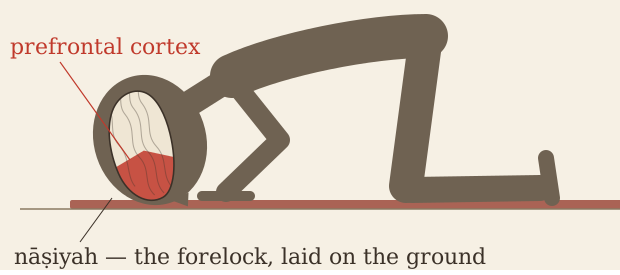
The Arabic nāṣiyah is the forelock: the hair and scalp at the very front of the head. What is remarkable is not merely that the Qur’an mentions the forehead, but that it attributes the specific behaviors of lying and sinfulness to that region itself—calling the forelock “lying” and “sinful,” as though the capacity for deceit resides there. Modern neuroscience places the work of lying in exactly that region. The first functional-imaging study of deception found lying associated with greater activity in the ventrolateral prefrontal cortex on both sides (Spence et al., 2001), and a meta-analysis of the studies that followed found prefrontal regions consistently more active for lies than for truthful answers (Christ et al., 2009). People who lie pathologically differ in the structure of the same region, with 22 to 26 per cent more prefrontal white matter than either normal or antisocial controls (Yang et al., 2005). Moral judgment and impulse control depend on the same cortex, situated directly behind the forehead.
The surah closes on the counter-image. Its last verse reads: “Do not obey him; prostrate, and draw near” ()—and in prostration the forehead is laid on the ground. The part of the body the surah has called lying is the part it asks the reader to lower. The same root draws the contrast with fu’ād: of the Prophet’s fu’ād the Qur’an says that it “did not lie (mā kadhaba) about what it saw” (). The fu’ād is the faculty that does not lie; the nāṣiyah is the one that does.
Alternate Explanation: Cross-Cultural Forehead Symbolism
Intellectual rigor requires considering that the forehead has been symbolically associated with character, identity, and moral status across many cultures long before neuroscience existed. In the Hebrew Bible, Jeremiah describes a prostitute’s “forehead” as a mark of shamelessness. In Hinduism, the tilaka marks the forehead as the seat of the ajna chakra—the “third eye” of wisdom and spiritual insight. In the Roman world, runaway slaves and some convicts were branded or tattooed on the forehead (Jones, 1987); Ezekiel marks the righteous on the forehead, and Revelation the followers of the beast. The forehead’s prominence and visibility have made it a cross-cultural symbol of a person’s inner character.
Could the Qur’an’s use of nāṣiyah simply draw on this widespread symbolic tradition rather than encoding neuroanatomical knowledge? The possibility cannot be excluded. However, a crucial distinction separates the Qur’anic usage from these parallels. Cross-cultural forehead symbolism is typically external—marks placed upon the forehead to signify status, identity, or punishment. The Qur’an knows that idiom and uses it. Of the slanderer portrayed in it says, “We will brand him upon the snout” (): a mark placed on the face, the cross-cultural pattern exactly. In it does something different: it attributes the cognitive functions of lying and sinfulness to the forelock itself, treating it as the organ responsible for moral failure. The phrase is not “a liar whose forehead we will seize” but “a lying, sinful forelock”—the nāṣiyah itself is described as the agent of falsehood. This internalization of moral function in the frontal region, rather than mere external marking, is what distinguishes the Qur’anic description and aligns it with what neuroscience would later discover.
Fu’ād and Qalb: A Crucial Linguistic Distinction
One of the chapter’s strongest claims rests on the Qur’an’s use of two distinct terms where English translations often collapse both into “heart.” The Arabic qalb (root q-l-b, “to turn”) appears 132 times in the Qur’an and functions as the stable seat of belief, reasoning, and spiritual orientation. It is where revelation is received (), where blindness to truth is diagnosed (), and where faith or disbelief resides.
Fu’ād (root f-‘-d, meaning “warmth” or “burning”) appears sixteen times and is consistently used in contexts of intense, dynamic perception—moments of acute clarity, emotional crisis, or truth verification. In , fu’ād validates the Prophet Muhammad’s vision (most classical commentators take it as a vision of Gabriel; some connect the passage with the Night Journey): “The mind did not make up what he saw” (Khalifa) or “The heart did not lie about what it saw” (Sahih International). In , fu’ād captures the raw, visceral grief of Moses’ mother, while qalb in the same verse denotes her strengthened, resolved faith. In , fu’ād is tasked with verifying information—a function requiring analysis, judgment, and the integration of sensory data.
Khalifa’s translation of fu’ād as “brain” is interpretive rather than literal—classical Arabic does not identify fu’ād with the anatomical brain, and traditional translators consistently render it as “heart.” However, the functional profile of fu’ād in the Qur’an—verification, synthesis, moral discernment—is consistent with prefrontal function as modern neuroscience describes it. The more precise statement is not that the Qur’an “anticipates” the prefrontal cortex, but that its description of fu’ād maps onto the same functional territory: a faculty that integrates sensory inputs into moral and intellectual clarity, distinct from the broader seat of belief (qalb), and requiring a lifetime of experience to mature.
The ’Alaq: Embryological Precision and Its Limits
The Qur’anic developmental narrative begins earlier than birth. Surah , widely regarded as the first revelation, declares that God created humanity from an ’alaq. The Arabic root ’-l-q conveys attachment, clinging, or suspension. Classical lexicons define ’alaq as something that adheres tenaciously—whether a leech, a suspended drop, or clinging blood. The term is richer than the common translation “blood clot,” which implies a static, coagulated mass. The more accurate rendering—a clinging, leech-like structure—corresponds to the early embryo at seven to twenty-four days post-fertilization: the blastocyst that clings to the uterine wall during implantation, or the gastrula whose curved, segmented form resembles a leech.
A reader who checks a translation at this point may stop short. Many of the most widely printed renderings — Pickthall, Yusuf Ali, Arberry — say “clot” or “clot of congealed blood,” and a clot is embryologically wrong: the embryo is never a clot of blood, and no stage of development resembles one. If the Qur’an said clot, this passage would be a mistake, not a sign. So it is worth being precise about where “clot” comes from — because it does not come from the word.
The root ʿ-l-q means to cling, to attach, to hang on. From that root the language derived several senses that already existed side by side before Islam: the leech, the clinging creature; thick, sticky blood — blood that clings; and anything that clings or hangs suspended. The classical lexicons, including Lane’s, record all of these together. How far back the blood sense goes is harder to establish than is often claimed. The line usually cited for it, attributed to Zuhayr ibn Abī Sulmā (d. c. 609 CE), describes a she-camel driven so hard that she miscarries ʿalaq; but the line is not in the early recensions of his dīwān and first surfaces in Ibn ʿAbd Rabbih’s al-ʿIqd al-farīd, three centuries later. What the lexicons do establish is that what unites the word’s senses is not blood but adhesion.
“Clot” entered the translations by way of the commentators, not the lexicon. The classical tafsīr tradition glossed the embryological verses almost unanimously as dam (blood) or al-dam al-jāmid (congealed blood) — the natural reading under the biology of the age, which held that the embryo formed from coagulated menstrual blood. The English translators followed the tafsīr, and “clot” hardened into the default rendering; only recent translations (Saheeh International’s “clinging clot,” Khattab’s “clinging clot,” others’ “clinging substance”) have moved back toward the root. This history should be read with both eyes open, because it cuts in a specific direction. The classical gloss shows what the seventh-century audience most likely heard: blood — their own era’s embryology, and no challenge to it. But the word itself never committed to that mechanism. It names a behavior, clinging; if the tradition had meant only coagulated blood, the leech would not carry the same name. When modern embryology found, at exactly the stage the verse names, a structure that clings to the uterine wall, invades it, and lives on maternal blood, the word did not need to be re-translated to fit. It needed only to be read at its root. The mistake to avoid is judging the Arabic by its translations: the translations record what earlier centuries understood; the word records what the text said.
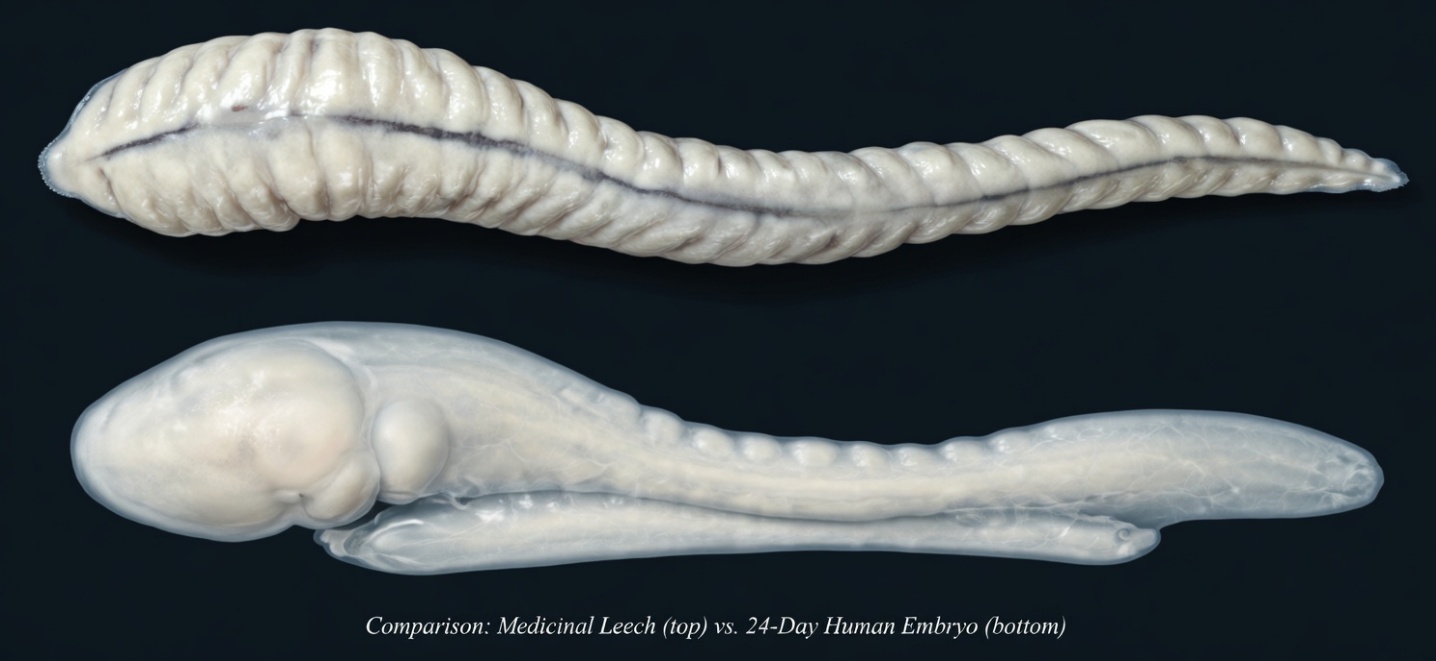
The leech comparison is usually presented as a matter of shape: the curved, segmented embryo of days twenty-two to twenty-four does look strikingly like a leech, as the figure shows. But the Arabic word carries a second meaning that shape alone does not exhaust. ʿAlaq is a thing that clings—and here the parallel deepens from appearance into function, because a leech is defined less by its outline than by what it does. It fastens onto a host and lives by drawing the host’s blood.
The early conceptus does exactly this, and the detail is more precise than any seventh-century observer could have known. When the blastocyst reaches the uterus about six days after fertilization, its cells have already divided their labor: the inner cell mass will become the child, while the outer layer—the trophoblast—will become the placenta. The placenta, in other words, is not the mother’s organ. It is grown by the conceptus itself and is genetically the child’s own tissue. That tissue burrows into the uterine lining, erodes the walls of the mother’s blood vessels, and by roughly the twelfth day maternal blood is flowing through channels the invading tissue has opened. From then until birth, the child lives by drawing oxygen and nutrients from the mother’s bloodstream. Human placentation is in fact the most invasive of the known types—hemochorial—in which the child’s tissue is bathed directly in the mother’s blood.
Even the leech’s signature trick has a placental counterpart. A feeding leech secretes anticoagulants into the wound so that its host’s blood keeps flowing — chief among them hirudin, a molecule so effective that medicine borrowed it. The placenta solves the identical problem with a whole battery of its own: tissue factor pathway inhibitor (TFPI), produced by placental vascular endothelium, and its placenta-specific variant TFPI-2, purified from the syncytiotrophoblast lining of the villi; thrombomodulin, carried on the syncytiotrophoblast’s apical membranes, which activates protein C, the body’s own anticoagulant; annexin V — first isolated from placental tissue and named, fittingly, placental anticoagulant protein — which coats the phospholipid surfaces where clotting would otherwise assemble; and dermatan sulfate, a glycosaminoglycan abundant in the placental stroma and fetal vessels, which activates heparin cofactor II, a thrombin inhibitor. Maternal blood, which clots on contact with almost any foreign surface, is kept liquid for nine months in the one place it flows past another being’s tissue. The word ʿalaq is therefore doubly apt. As form, it names what the embryo looks like in its fourth week. As function, it names what the clinging tissue does for the rest of the pregnancy: it holds fast, and it feeds on blood. The first meaning describes an appearance; the second describes a hidden function — one that operates at an interface no unaided eye had ever seen, and that was not understood until modern placentology described it.
Loading…
Keith L. Moore, Professor Emeritus of Anatomy at the University of Toronto and author of the widely used textbook The Developing Human, analyzed these terms at a 1981 conference in Dammam, Saudi Arabia, and noted the alignment between Qur’anic terminology and embryological stages. His observation that the ’alaqah stage resembles a leech in both appearance and function has been widely cited.
However, Moore’s endorsement requires context. His involvement with Qur’anic embryology was facilitated through the Embryology Committee of King Abdulaziz University. A special third edition of his textbook, The Developing Human: Clinically Oriented Embryology with Islamic Additions (1983), was co-authored with Abdul Majeed al-Zindani and produced specifically for Islamic universities. By 2002, Moore declined to discuss the subject with the Wall Street Journal, stating it had been more than a decade since his involvement. The “Islamic Additions” in his co-authored edition were primarily al-Zindani’s contributions, not Moore’s original work. None of this invalidates Moore’s substantive observation about ’alaqah’s embryological correspondence, but it does mean his statements should be treated as those of a scientist commenting on an interesting alignment, not as an unqualified endorsement of the argument for divine authorship.
Verse describes the physical progression:
Surah Al-Mu'minun · 23:14المؤمنونثُمَّ خَلَقۡنَا ٱلنُّطۡفَةَ عَلَقَةٗ فَخَلَقۡنَا ٱلۡعَلَقَةَ مُضۡغَةٗ فَخَلَقۡنَا ٱلۡمُضۡغَةَ عِظَٰمٗا فَكَسَوۡنَا ٱلۡعِظَٰمَ لَحۡمٗا ثُمَّ أَنشَأۡنَٰهُ خَلۡقًا ءَاخَرَۚ فَتَبَارَكَ ٱللَّهُ أَحۡسَنُ ٱلۡخَٰلِقِينَThen we developed the drop into a clinging organism, then developed the clinging organism into a chewed-like lump of flesh, then we developed the chewed-like lump of flesh into bones, then we clothed the bones with flesh, then we produced it into another creation. Most blessed is God, the best Creator.KhalifaThen We made the sperm-drop into a clinging clot, and We made the clot into a lump [of flesh], and We made [from] the lump, bones, and We covered the bones with flesh; then We developed him into another creation. So blessed is Allah, the best of creators.Sahih InternationalArabic: Uthmani text via quran-json
The Galenic Parallel: Similarity, Transmission, and the Question of Access
The most serious scholarly challenge to Qur’anic embryological claims is the parallel with Galen of Pergamon (c. 129–216 CE), who described four stages of embryonic development roughly 450 years before the Qur’an. In his treatise De Semine (On Semen), Galen described: (1) the form of semen, (2) a bloody, vascularized form with ill-defined organs, (3) a fleshy form in which limbs begin to take shape, and (4) the fully formed and quickened fetus. These stages bear structural similarity to the Qur’anic sequence of nutfah (drop), ’alaqah (clinging/blood), mudghah (chewed-like lump), and the clothing of bones with flesh. The historian Basim Musallam noted that medieval Islamic physicians used Qur’anic terminology to describe Galenic stages, and Joseph Needham, a leading historian of embryology, characterized the Qur’anic descriptions as a seventh-century echo of Aristotle and the Ayurveda.
If the Qur’an simply restated Galenic theory, its embryological claims would lose their force as evidence of foreknowledge. This objection deserves the most thorough examination. The critical question is not merely whether a similarity exists—it does—but whether a plausible mechanism of transmission existed by which Galen’s specific embryological stages could have reached Muhammad in seventh-century Mecca.
The Language Barrier
Galen wrote in Greek. His works were first translated into Syriac by Sergios of Resh’Aina (d. 536 CE), a Christian priest who studied medicine in Alexandria and worked in Mesopotamia. These Syriac translations were studied in the Christian monastic schools of Edessa and Nisibis, and later at the Academy of Jundishapur in Sassanid Persia. Crucially, no Arabic translations of Galen existed during Muhammad’s lifetime. The earliest Arabic medical translations are reported from the Umayyad period (661–750 CE), decades after Muhammad’s death in 632 CE; systematic translation began only under the Abbasids after 750 and reached its height in ninth-century Baghdad, where the caliph al-Ma’mun (r. 813–833) enlarged the palace library known as the House of Wisdom—nearly two centuries after Muhammad. The great translator Hunayn ibn Ishaq (809–873 CE), who produced the definitive Arabic versions of Galen, was born 177 years after Muhammad died.
In Muhammad’s time, Galenic knowledge existed in Greek, Syriac, and Pahlavi (Middle Persian)—none of which were languages spoken or understood in the Hijaz. Arabic was the language of the Arabian Peninsula, and Mecca, while a significant trading hub, was a commercial center, not a scholarly one. The intellectual infrastructure for accessing Greek medical texts simply did not exist in western Arabia during the early seventh century.
The Geography of Knowledge
The Academy of Jundishapur—the institution most often cited as the bridge between Greek medicine and the Islamic world—was located in Khuzestan, southwestern Persia, over 1,400 kilometers from Mecca. It was a Sassanid institution that integrated Greek, Indian, and Persian medical traditions, with Galenic texts forming a core part of its curriculum. But its scholars wrote in Syriac and Pahlavi, its students were Persian, Nestorian Christian, Jewish, and Zoroastrian elites, and its influence radiated toward the Sassanid and later Abbasid courts—not toward the Arabian interior.
Pre-Islamic Arabia’s medical landscape has been described by historians as folk medicine characteristic of a largely oral, nomadic society. As one medical history notes, “The harsh environment, isolation in the desert, the nomadic Bedouin life, and the general illiteracy explain the low level of medical knowledge among Arabs before Islam” (Saad & Said, 2011). Arabian medical practices of the era consisted primarily of hijamah (cupping), kayy (cautery), herbal remedies, and dietary advice—practical, experiential medicine with no known theoretical framework derived from Greek philosophy. There were no libraries, no translated texts, no schools of anatomy in the Hijaz.
Al-Harith ibn Kalada: The Only Proposed Link
The only individual proposed as a direct transmission link between Galenic medicine and Muhammad is al-Harith ibn Kalada al-Thaqafi (d. c. 634 CE), a physician from Ta’if who is said by some later historians to have studied medicine at Jundishapur. The argument, advanced by critics such as the anonymous Christian author “Lactantius,” proposes that al-Harith learned Galenic embryology at Jundishapur, returned to Arabia, and transmitted this knowledge to Muhammad, who then incorporated it into the Qur’an.
This hypothesis faces formidable obstacles on multiple fronts:
First, al-Harith’s historical existence as a Greek-trained physician is disputed. Historians Manfred Ullmann and Franz Rosenthal consider al-Harith a “legendary figure” with literary rather than historical attributes. Gerald Hawting, Professor of the History of the Near and Middle East at SOAS, University of London, argues that the biographical details linking al-Harith to Persia and Jundishapur were likely elaborated by later writers with a motive of their own: to connect early Islam with the prestige of Hellenistic medical learning (Hawting, 1989). The medical historian Plinio Prioreschi has noted that no Persian sources substantiate the claim that Jundishapur played a significant role in medicine during this period, and that from the fifth to the seventh century, the institution has no other historically authenticated students.
Second, even if al-Harith did study at Jundishapur, nothing in the reports of his practice is Galenic. The best-known of them, in Abu Dawud’s Sunan (no. 3875), has Muhammad visit the sick Sa’d ibn Abi Waqqas and send him to al-Harith, “a man who practises medicine,” with the instruction to take seven ʿajwa dates of Medina, crush them with their stones, and put them in his mouth. Al-Albani grades the report weak (ḍaʿīf); taken at face value, it shows the two men known to each other, and the remedy it records is a folk remedy, not the theoretical framework of Greek humoral medicine. There is no record of al-Harith discussing embryological stages, anatomical theory, or any other element of Galenic doctrine.
Third, the chronology does not support transmission. Al-Harith was of Thaqif, the tribe of Ta’if, and Ta’if did not come under Muslim control until 630 CE, after the Conquest of Mecca. Muhammad did go there earlier: in 619, after the deaths of Abu Talib and Khadijah, he preached to the leaders of Thaqif and was driven out of the town. But no report places al-Harith in Muhammad’s company during the Meccan years, and the reports that connect the two men at all, like the one above with its dates of Medina, point to the years after the Hijra. Meanwhile the embryological vocabulary was already in circulation: ʿalaq appears in , among the first verses revealed, around 610—nine years before the visit to Ta’if—and the fuller sequence of belongs, according to the classical exegetes Ibn Kathir, al-Baghawi, and al-Qurtubi, to a surah revealed entirely in Mecca. With no documented contact before the Hijra, al-Harith cannot be shown to have been their source.
Fourth, the reports of al-Harith’s Islam cut against the plagiarism thesis rather than for it—though here the sources disagree, and the argument has to be stated on both branches. Al-Qifti records that al-Harith accepted Islam; Ibn ʿAbd al-Barr and Ibn al-Athir say that his Islam is not established. If he did convert, it is hard to explain why an educated physician who recognized Galenic embryology in the Qur’an, and believed Muhammad had simply copied it, would then accept him as a prophet. If he did not, the borrowing thesis is left with a physician outside Muhammad’s community whose only documented contact with him is a weak report about dates. On either branch, the reports do not supply the pathway the borrowing hypothesis requires.
Could Knowledge Have Traveled Orally Through Trade Routes?
A more diffuse version of the transmission argument suggests that Greek medical ideas could have filtered into Arabian awareness through trade contacts, without requiring Muhammad to have read Galen or met a specific intermediary. Mecca sat on the incense trade route connecting Yemen to Syria, and Meccan merchants traveled to Damascus, Gaza, and occasionally further. Could general ideas about embryological stages have traveled along these routes?
This is the most difficult version of the objection to dismiss entirely, because oral transmission leaves no documentary trace to either confirm or refute. However, several considerations weigh against it. Trade caravans exchanged goods, not medical lectures. The merchants of Quraysh—Muhammad’s tribe—were known for commerce, poetry, and tribal politics, not for interest in Greek natural philosophy. There is no record in the pre-Islamic Arabian literary tradition (jāhiliyyah poetry, tribal oratory, or the preserved sayings of pre-Islamic sages) of anything resembling Galenic embryological theory. If such ideas were circulating in Meccan society, one would expect some trace in the substantial surviving corpus of pre-Islamic Arabic literature. None has been identified.
Moreover, the Qur’an itself addresses this objection. When Muhammad’s contemporaries accused him of receiving his revelations from human sources, the Qur’an responded in 16:103:
Surah An-Nahl · 16:103النحلوَلَقَدۡ نَعۡلَمُ أَنَّهُمۡ يَقُولُونَ إِنَّمَا يُعَلِّمُهُۥ بَشَرٞۗ لِّسَانُ ٱلَّذِي يُلۡحِدُونَ إِلَيۡهِ أَعۡجَمِيّٞ وَهَٰذَا لِسَانٌ عَرَبِيّٞ مُّبِينٌWe know that they say, ‘A human being is teaching him!’ The tongue of the source they hint at is non-Arabic, and this is a perfect Arabic tongue.Arabic: Uthmani text via quran-json
The verse acknowledges the accusation of human sourcing and rejects it on linguistic grounds—the Qur’an’s Arabic was of a caliber beyond what a foreign instructor, communicating across a language barrier, could produce.
The conclusion is that oral transmission, while not impossible to imagine in the abstract, is improbable given what we know of the culture that would have had to carry it. No documented chain connects Galenic embryology to seventh-century Mecca. No trace of theoretical embryology appears in the substantial surviving corpus of pre-Islamic literature. The oral culture that did exist—extraordinary as it was—operated in domains entirely unrelated to natural philosophy or systematic medicine. The naturalistic hypothesis requires not merely that someone mentioned Galen’s ideas along a trade route, but that those ideas survived translation across languages, reformulation into a non-scientific oral culture, and preservation with enough precision to produce the Qur’anic description—all without leaving a single trace in the historical record. This is not impossible, but it is not probable. The burden of the transmission argument falls on the party asserting it, and that assertion has not, to date, produced a specific, evidenced pathway.
The Galenic Parallel in Perspective
Taken together, the evidence presents a significant barrier to the borrowing thesis. The linguistic gap (no Arabic translations of Galen existed), the geographic distance (over 1,400 km between Jundishapur and Mecca), the social context (an oral, commercial society with no intellectual infrastructure for Greek philosophy), the disputed historicity of the only proposed intermediary, the absence of any documented contact between that intermediary and Muhammad before the relevant verses were in circulation, and the total absence of Galenic ideas in pre-Islamic Arabic literature—all weigh against a direct or indirect transmission of Galenic embryology to Muhammad.
This does not mean the similarity with Galen is unimportant. A thorough analysis must acknowledge that the embryological stages described in the Qur’an do bear structural resemblance to Galenic theory, and that both could reflect observations available through the examination of miscarried fetuses—a practice documented in both Greek and Arabian contexts. The embryological parallel, taken alone, remains a point of legitimate debate. What the transmission analysis demonstrates, however, is that the pathway by which Galen’s specific theoretical framework could have reached an unschooled merchant in Mecca is far more tenuous than critics have sometimes suggested. And it is worth reiterating that the argument of this chapter rests primarily on claims that have no Galenic parallel: the hearing–eyesight–fu’ād developmental sequence, the attribution of lying to the nāṣiyah, and the fu’ād/qalb distinction.
Lens-Invariance: Why the Vocabulary Survives the Move Past Galen
The transmission analysis above settles whether Galenic embryology was available to a seventh-century Arabian author. The conclusion was that it was not — no Arabic translations existed, the language barrier was real, the Hijaz was not a scholarly center, and the proposed transmission link through al-Ḥārith ibn Kalada is too thin to carry the weight critics ask of it. This is the historical-availability defense, and it does its work.
But there is a second test the embryological vocabulary has to pass, and the test is harder. Even if some version of Galen’s framework had reached Mecca, the Qur’an’s terms would have to survive not just transmission but successive revision of the framework Galen proposed. Galen’s embryology, in its full form, has been substantially overturned by modern developmental biology. If the Qur’an’s terms were locked to Galen’s specific mechanism, they would be falsified along with Galen. The fact that the terms continue to read coherently against modern embryology — read deeper, in fact, than they could have read under Galen — is a property worth naming explicitly. It is what the introduction calls lens-invariance, and the embryological vocabulary illustrates it cleanly.
Consider what Galen’s framework actually held about the four stages of development.
For Galen, the form of semen (stage one) was a residue of blood “concocted” in the testes through male heat. The seed contained both male and female contributions — a position Galen defended against Aristotle, who had granted the female a passive nutritive role only — but the contributions were imagined as fluid mingling, not as cellular fusion. There was no germ-line, no cellular biology, no chromosomal recombination. The “drop” was a hot, refined, blood-derived secretion.
For Galen, the bloody, vascularized form (stage two) was the early embryo developing through the action of innate heat on the seed-fluid, taking on a primitive vascular pattern as the pneuma worked through it. The mechanism was humoral and qualitative.
For Galen, the fleshy form (stage three) and the fully formed and quickened fetus (stage four) were progressive concoctions of the same substrate — flesh first, then organs and limbs, with bones forming later as a hardening of certain tissues under sustained heat.
Modern developmental biology has revised every one of these mechanisms. The “drop” is now understood as a haploid sperm cell carrying half the genetic complement, fertilizing a haploid ovum, and producing a diploid zygote with chromosomal recombination. The implantation stage involves a blastocyst (not a “bloody form”) burrowing into the endometrium. Limb and organ development is now understood through gastrulation, neurulation, and the establishment of the three germ layers (ectoderm, mesoderm, endoderm), with bones forming via endochondral and intramembranous ossification rather than through hardening of pre-existing flesh.
Galen’s specific mechanisms are wrong. Galen’s specific causes — innate heat, pneuma, humoral concoction — have been replaced. A text whose embryology was committed to Galen’s framework would be falsified along with Galen. This is the test the Qur’anic vocabulary has to pass.
It does pass it, and it does so because the Qur’an’s vocabulary was never committed to Galen’s mechanism. Examine the four key terms:
Nuṭfah (نطفة) means “a small drop” or “a trickle” — a generic term for a small quantity of fluid. The word does not specify what the fluid is made of, what its chemical composition is, what its cellular content is, or how it was produced. A Galenic reader could map nuṭfah onto blood-derived semen and find the term consistent with his framework. A modern reader can map nuṭfah onto the haploid gametic fluid carrying chromosomes and find the term consistent with his framework. The word itself adjudicates between neither. It picks out the quantity and form (a drop), not the mechanism of how the drop was produced or what it carries.
ʿAlaqah (علقة) means “something that clings” or “something suspended” — derived from a root (ʿ-l-q) meaning attachment. Lexically, the term encompasses leeches, suspended drops, and clinging blood. A Galenic reader could read ʿalaqah as the bloody, vascularized form of stage-two embryology and find the term consistent with the humoral picture. A modern reader can read ʿalaqah as the implanting blastocyst clinging to the uterine wall — a biological structure that literally clings, with characteristic shape resembling a leech, as Keith Moore observed. The word adjudicates between neither mechanism. It picks out the behavior of the structure (clinging, attachment) and its appearance (leech-like), not the underlying biology. And the functional reading developed earlier in this chapter—the clinging tissue becomes the placenta and draws the mother’s blood for the rest of the pregnancy—sits at the same level of description: behavior, not mechanism.
Muḍghah (مضغة) means “a chewed lump” — the literal etymology refers to a piece of food worked over by chewing. A Galenic reader could read muḍghah as the early fleshy mass of stage-three embryology and find the term consistent with concoction-driven development. A modern reader can read muḍghah as the somite-stage embryo, whose surface bears bite-mark-like indentations as the somites differentiate — a description that, on close embryological imaging, is visually accurate to what a seventh-century reader would have understood by “a chewed lump.” Again, the word adjudicates between neither mechanism. It describes the appearance, not the cause.
ʿIẓām thumma kasawńā al-ʿiẓāma laḥmā — “bones, then We clothed the bones with flesh.” A Galenic reader could read this against the concoction-driven hardening sequence and find the verse consistent with his framework, though noting that Galen actually placed flesh-formation before bone in some passages. A modern reader has to be more careful than the popular presentations are. Muscle precursor cells appear early—the myotomes of the somites form in the fourth and fifth weeks, and myoblasts have entered the limb buds by the fifth—so the verse cannot be read as saying that no flesh exists until bone does. What it can be read as describing is the arrangement. The skeleton is laid down as a framework first: the cartilage models of the limb bones form in the sixth week and begin to ossify from the seventh, and over the same weeks the limb muscle masses split into individual muscles arranged around and attached to that framework. On that reading—bones formed, then clothed—the verse’s order is closer to the embryological record than Galen’s flesh-first order.
This last point is the critical one for lens-invariance. The bones-then-flesh sequence is not just compatible with both frameworks; it is more accurate under modern embryology than it was under Galen’s. The verse does not commit to Galen’s order; it states an order that turns out to match what modern embryology shows. A reader applying a strict Galenic lens to the verse would have read it as roughly correct (with some tension over the exact ordering); a reader applying a modern embryological lens reads it as correct at the level the verse speaks—flesh arranged upon a skeleton already laid down—and as wrong only if it is pressed into claiming that no muscle cell exists before bone.
This is what lens-invariance looks like in operation. The Qur’an’s embryological vocabulary is positioned at a level of description — appearance, behavior, observable form, sequential ordering — that does not commit to the underlying mechanism. Galen’s mechanism could be wrong, and the Qur’an’s terms still read correctly. Modern mechanisms could turn out to be partially revised in some future biology, and the Qur’an’s terms would likely still read correctly under that revision, because they describe what the structures look like and do, not what causes them to exist.
This is harder to produce by chance than it appears. A seventh-century author drawing on Galenic medicine would naturally use Galenic mechanism-terms — humors, concoction, pneuma, innate heat — and the resulting text would be falsified when Galen was overturned. A seventh-century author wholly innocent of Galen would describe embryology in folk terms (probably about the womb’s heat, the action of jinn, or astrological influence) — and the resulting text would be falsified the moment any rigorous medical framework, Galenic or modern, was applied.
The Qur’an does neither. It uses nuṭfah (a drop), ʿalaqah (something clinging, leech-like), muḍghah (a chewed lump), and ʿiẓām thumma laḥm (bones then flesh) — terms that name observable forms and sequences without naming the mechanism. Under Galen, these terms read as correct because the observable forms map onto Galen’s stages. Under modern embryology, the same terms read as correct because the observable forms also map onto blastocyst implantation, somite differentiation, and a skeleton laid down before the muscles are arranged upon it. The verse passes both lenses.
The transmission analysis answered one question: was Galen available to the seventh-century author? The answer was no. The lens-invariance analysis answers a different question: would Galenic availability have helped the author produce a text that survives the move past Galen? The answer is also no. A Galenic-derivative text would be falsified along with Galen. The Qur’an’s terms survive because they were never Galenic in their commitments to begin with. They are positioned at a level Galen could endorse and modern biology can also endorse — and the seventh century, working from any framework available to it, could have endorsed too.
The cumulative force of the embryological evidence in this chapter therefore rests on two findings, not one. The transmission case (Galen was not available) handles the historical-availability objection. The lens-invariance case (the vocabulary survives Galen being overturned) handles the deeper objection that even if Galen had been available, a Galenic-derivative text would have been falsified by twentieth-century embryology. Both objections are answered as far as the evidence allows. What remains is a verse that names a developmental sequence in terminology readable as accurate under successive frameworks — including frameworks whose mechanisms contradict each other. That is the property the introduction’s Note on Discovery and Design identified as lens-invariance, and the embryological vocabulary illustrates it cleanly.
A reader who has accepted the transmission case and the lens-invariance case has accepted that, on the evidence available, neither natural-authorship explanation accounts for the verse’s specificity — though oral transmission, as the chapter grants, cannot be excluded entirely. The verse does not derive from Galen because Galen was not transmissible; it does not survive modern biology by accident because the survival is too clean and too sustained across multiple terms. What remains for the reader is to weigh this finding against the cumulative evidence the rest of the book examines.
What Has No Known Precedent
Setting aside the embryological material—which exists within a contested scholarly landscape—several features of the Qur’anic text remain without identified parallels in prior literature:
Loading…
1. The consistent hearing–eyesight–fu’ād sequence. No Greek, Indian, or Near Eastern text prior to the Qur’an presents this specific ordering as a developmental or epistemic framework. Aristotle discussed the senses but did not sequence them developmentally against a culminating moral faculty. Galen described embryonic stages but not sensory-developmental priorities.
2. The nāṣiyah as the seat of deceit. While forehead symbolism existed across cultures, no prior text attributable to the seventh-century Near East identifies the frontal region as the organ responsible for lying. The Qur’anic formulation is functional, not decorative: it describes the forelock as the source of sinfulness, not merely a location where punishment is applied.
3. The fu’ād/qalb distinction. The use of two separate terms for inner perception, with fu’ād reserved for dynamic, verifying insight and qalb for stable belief, appears to be a Qur’anic innovation. This distinction, applied consistently across the word’s sixteen occurrences, creates a nuanced psychology of moral cognition that maps onto the modern differentiation between executive function (prefrontal cortex) and broader emotional-motivational states (limbic system).
4. The developmental ordering matches biology. Fetal auditory response from nineteen weeks, postnatal visual maturation, and prefrontal myelination continuing into adulthood — this timeline was established only through technologies like ultrasound (1950s), electroencephalography, and functional MRI (1990s). The Qur’an’s sequence is consistent with this developmental arc, and the specificity of its ordering — always hearing first, always fu’ād last — argues against coincidence.
The consistency itself constitutes a form of pre-registration. By fixing the sequence—always hearing first, always fu’ād last—across six independent verses, and only where the word is fu’ād, the Qur’an creates a testable prediction: if the order reflects developmental biology, then auditory processing should mature before vision, and prefrontal function should mature last. The text does not leave the analyst free to select which verses to examine or which ordering to test. The pattern is set; the question is only whether it corresponds to reality.
When Fu’ād Fails: The Qur’anic Warning and Its Neurological Echo
The Qur’an contrasts the cultivation of fu’ād with its neglect. Verse describes those who squander their faculties:
Surah Al-A'raf · 7:179الأعرافوَلَقَدۡ ذَرَأۡنَا لِجَهَنَّمَ كَثِيرٗا مِّنَ ٱلۡجِنِّ وَٱلۡإِنسِۖ لَهُمۡ قُلُوبٞ لَّا يَفۡقَهُونَ بِهَا وَلَهُمۡ أَعۡيُنٞ لَّا يُبۡصِرُونَ بِهَا وَلَهُمۡ ءَاذَانٞ لَّا يَسۡمَعُونَ بِهَآۚ أُوْلَـٰٓئِكَ كَٱلۡأَنۡعَٰمِ بَلۡ هُمۡ أَضَلُّۚ أُوْلَـٰٓئِكَ هُمُ ٱلۡغَٰفِلُونَWe have committed to Hell many humans and jinns; they have minds with which they do not understand, eyes with which they do not see, and ears with which they do not hear. They are like animals; no, they are worse, for they are totally unaware.KhalifaArabic: Uthmani text via quran-json
In Sūrat al-ʿAlaq, the moral portrait that ends in the “lying, sinful forelock”—a man who transgresses because he thinks himself self-sufficient (), who forbids a servant to pray (), who denies the truth and turns away (), and who will not desist ()—reads like a clinical description of prefrontal disinhibition: restraint overridden, contempt for others, and deceit. Harlow’s words for Gage after the injury were “irreverent” and “impatient of restraint or advice when it conflicts with his desires”; and these behaviors are consistent with findings from lesion studies and neuroimaging research conducted over the past three decades.
Verse offers the counterpoint: “They are the ones who examine all words, then follow the best. These are the ones whom God has guided; these are the ones who possess intelligence” (Khalifa).
Fu’ād, when cultivated through reflection and adherence to truth, enables discernment—the capacity to weigh information, resist impulse, and align conduct with verified knowledge. This is the functional profile of a mature prefrontal cortex.
A Faculty That Takes a Lifetime
The Qur’an’s developmental arc — from ’s “knowing nothing” at birth, through the gifts of hearing and vision, to the slow cultivation of fu’ād — mirrors the neuroscience of brain maturation. Hearing is functional before birth. Vision matures within the first year. But the prefrontal cortex, which governs the capacities fu’ād describes — ethical judgment, impulse control, truth verification — undergoes synaptic pruning and myelination throughout childhood and adolescence and continues maturing well into adult life.
This extended developmental timeline gives fu’ād its Qur’anic weight. It is not a faculty one is born with; it must be cultivated. The Qur’an’s emphasis on accountability (), gratitude (), and reflection () frames this cultivation as a lifelong spiritual discipline—one that transforms raw sensory experience into moral insight. The warning of suggests that neglecting this development risks a kind of spiritual prefrontal failure: the capacity for lying, sinfulness, and moral blindness that arises when the highest human faculty is left undeveloped.
There is one more convergence, and it is the strangest. The Qur’an names an age. In the one verse where the text attaches a number to full human maturity, the arc runs from gestation through weaning and then leaps past every physical milestone:
Surah Al-Ahqaf · 46:15الأحقافوَوَصَّيۡنَا ٱلۡإِنسَٰنَ بِوَٰلِدَيۡهِ إِحۡسَٰنًاۖ حَمَلَتۡهُ أُمُّهُۥ كُرۡهٗا وَوَضَعَتۡهُ كُرۡهٗاۖ وَحَمۡلُهُۥ وَفِصَٰلُهُۥ ثَلَٰثُونَ شَهۡرًاۚ حَتَّىٰٓ إِذَا بَلَغَ أَشُدَّهُۥ وَبَلَغَ أَرۡبَعِينَ سَنَةٗ قَالَ رَبِّ أَوۡزِعۡنِيٓ أَنۡ أَشۡكُرَ نِعۡمَتَكَ ٱلَّتِيٓ أَنۡعَمۡتَ عَلَيَّ وَعَلَىٰ وَٰلِدَيَّ وَأَنۡ أَعۡمَلَ صَٰلِحٗا تَرۡضَىٰهُ وَأَصۡلِحۡ لِي فِي ذُرِّيَّتِيٓۖ إِنِّي تُبۡتُ إِلَيۡكَ وَإِنِّي مِنَ ٱلۡمُسۡلِمِينَUntil, when he reaches full strength and reaches forty years, he says, ‘My Lord, enable me to be grateful for Your favor which You have bestowed upon me and upon my parents, and to work righteousness of which You will approve.’Arabic: Uthmani text via quran-json
The verse pairs two conditions — balagha ashuddahū, he reached his full strength, and balagha arbaʿīna sanah, he reached forty years — as though physical adulthood alone were not the finish line. And the figure the verse describes at forty is doing distinctly fuʾād-work: weighing a life, acknowledging debts, choosing a course and asking to be held to it. The tradition reinforces the number — prophethood itself came at forty. Whatever the verse means by full maturity, it is not the body, which peaks decades earlier.
Modern imaging offers a candidate for what is still unfinished at thirty-nine, and the evidence should be stated with its limits attached. The gray-matter story — the cortical maturation mapped by Gogtay and colleagues, in which higher-order association cortex matures after sensory and motor areas — is drawn from a cohort aged four to twenty-one, so it establishes the ordering rather than a completion age, and prefrontal cortex is among the last regions rather than unambiguously the last. What extends the picture into adulthood is the white matter. Longitudinal diffusion imaging of subjects to age thirty-two shows association-tract maturation continuing past adolescence, while projection and commissural tracts finish earlier (Lebel and Beaulieu 2011); and volumetric imaging of men aged nineteen to seventy-six finds frontal white-matter volume increasing until age forty-four, and temporal until forty-seven (Bartzokis et al. 2001). The faculty this chapter has located in the prefrontal cortex is not merely the last to mature; the insulation of its circuitry peaks near the age the Qur’an names.
The alignment should be stated with the usual care. Forty was a resonant round number across the ancient Near East, and the imaging literature reports a peak spread across the fifth decade, not a birthday. But notice the direction of the claim. A seventh-century text tying full maturity to age had every visible cue pointing at twenty — strength, stature, and every observable capacity peak early. It chose instead an age at which nothing visible about a person is still developing. The one tissue still measurably building at forty, invisible to any observer before magnetic resonance imaging, is the white matter of the judgment circuits.
Conclusion
This chapter has argued that the Qur’an’s consistent sequence of hearing, eyesight, and fu’ād—combined with its attribution of lying and sinfulness to the nāṣiyah and its distinction between fu’ād and qalb—constitutes a framework strikingly consistent with modern developmental neuroscience. The alignment is not limited to vague generalities: it involves a specific ordering that matches biological timelines, a specific anatomical localization that matches the prefrontal cortex’s role in moral cognition, and a specific linguistic distinction that maps onto the differentiation between executive function and broader emotional states.
Alternate explanations have been considered at length: the intuitive accessibility of the general sequence, the cross-cultural symbolic significance of the forehead, and the Galenic parallels in embryological description. The Galenic objection, in particular, has been examined in detail—not merely as a matter of textual similarity, but as a question of historical transmission. The analysis reveals that no Arabic translation of Galen existed during Muhammad’s lifetime; that the only proposed intermediary is a historically disputed figure whose reported medicine bore no resemblance to Greek theory; that the relevant Qur’anic verses were in circulation before any documented contact with that intermediary; that no trace of Galenic ideas exists in pre-Islamic Arabic literature; and that the social and linguistic conditions of seventh-century Mecca provided no plausible channel for the transmission of specialized Greek medical knowledge to an unschooled merchant.
These findings do not, in themselves, constitute proof of divine authorship—no historical argument can achieve that certainty. But they significantly narrow the field of available explanations. The Qur’an’s author, whoever one believes that to be, articulated a model of human cognitive development—from sensory perception through moral reasoning, localized in the frontal region of the brain—that would not be corroborated by experimental science for over twelve centuries. For the believer, this is consistent with the Qur’an’s own claim in 41:53:
Surah Fussilat · 41:53فصلتسَنُرِيهِمۡ ءَايَٰتِنَا فِي ٱلۡأٓفَاقِ وَفِيٓ أَنفُسِهِمۡ حَتَّىٰ يَتَبَيَّنَ لَهُمۡ أَنَّهُ ٱلۡحَقُّۗ أَوَلَمۡ يَكۡفِ بِرَبِّكَ أَنَّهُۥ عَلَىٰ كُلِّ شَيۡءٖ شَهِيدٌWe will show them Our signs in the horizons and within themselves until it becomes clear to them that it is the truth.Arabic: Uthmani text via quran-json
For the scholar, it is a phenomenon that warrants continued investigation rather than premature dismissal.
The Claim in Brief
The same five questions close every evidence chapter, so the claims can be compared on the same terms. Scores and verdicts are deliberately left out.
| What does the text say? | Six verses (, , , , , ) name samʿ (hearing), baṣar (eyesight) and fuʾād, always in that order, read here as a developmental sequence; calls the nāṣiyah (forelock) “lying, sinful”; and with describes creation from ʿalaq and a nuṭfah–ʿalaqah–muḍghah–bones-then-flesh sequence. The words carry ranges: fuʾād is traditionally “heart”, k-dh-b covers lying and denying the truth, and ʿalaq can mean leech, clinging blood, or anything that clings. |
|---|---|
| What would we expect historically? | The broad order — sound before sight, judgment with age — was observable to any attentive parent or midwife, the forehead was a cross-cultural symbol of character, and the classical tafsir read ʿalaq as blood. Galen’s four-stage embryology existed in Greek, Syriac and Pahlavi but had no Arabic translation in Muhammad’s lifetime, and the Hijaz had folk medicine without a theoretical framework, libraries or schools of anatomy. |
| What is the strongest supporting evidence? | The order is fixed in all six verses where the third term is fuʾād (with qalb it moves around), and it matches the developmental record: fetal responses to sound from about nineteen weeks, vision maturing after birth, prefrontal maturation continuing into adulthood. attributes lying to the forelock itself, and lying and moral judgment engage the prefrontal cortex behind it. The embryological terms name form and behaviour rather than mechanism, so they still read coherently under modern embryology, and no documented channel carried Galen to Mecca. |
| What is the strongest objection? | The Galenic parallel is the most serious scholarly challenge: Galen’s four stages, about 450 years earlier, resemble the Qur’anic sequence in structure, and oral transmission along trade routes is the hardest version of the objection to dismiss entirely. For the sequence and the forelock, the general order was observable and the text may draw on widespread forehead symbolism, a possibility the chapter says cannot be excluded. |
| What remains unresolved? | The embryological parallel, taken alone, remains a point of legitimate debate; the bones-then-flesh reading is wrong if pressed to mean no muscle exists before bone; and fuʾād is said to map onto prefrontal function, not to name the brain. The findings do not constitute proof of divine authorship, but they narrow the field of available explanations. |
References
Abu Dawud al-Sijistani (d. 889). Sunan, Kitāb al-ṭibb, no. 3875. (Saʿd ibn Abi Waqqas sent to al-Ḥārith ibn Kalada; graded ḍaʿīf by al-Albani.)
Bartzokis, G., Beckson, M., Lu, P. H., Nuechterlein, K. H., Edwards, N., & Mintz, J. (2001). Age-related changes in frontal and temporal lobe volumes in men: A magnetic resonance imaging study. Archives of General Psychiatry, 58(5), 461–465. (Cross-sectional; 70 healthy men aged 19–76. Frontal white-matter volume increases until age 44, temporal until 47.)
Christ, S. E., Van Essen, D. C., Watson, J. M., Brubaker, L. E., & McDermott, K. B. (2009). The contributions of prefrontal cortex and executive control to deception: Evidence from activation likelihood estimate meta-analyses. Cerebral Cortex, 19(7), 1557–1566.
DeCasper, A. J., & Fifer, W. P. (1980). Of human bonding: Newborns prefer their mothers’ voices. Science, 208(4448), 1174–1176.
Dobson, V., & Teller, D. Y. (1978). Visual acuity in human infants: A review and comparison of behavioral and electrophysiological studies. Vision Research, 18(11), 1469–1483. (Reports acuity in cycles per degree and notes that behavioural and evoked-potential methods disagree; the familiar “20/400” figure is a clinical rounding rather than a value stated in this review.)
Damasio, A. R. (1994). Descartes’ Error: Emotion, Reason, and the Human Brain. G. P. Putnam’s Sons. (The somatic marker hypothesis.)
Damasio, H., Grabowski, T., Frank, R., Galaburda, A. M., & Damasio, A. R. (1994). The return of Phineas Gage: Clues about the brain from the skull of a famous patient. Science, 264(5162), 1102–1105.
Gogtay, N., Giedd, J. N., Lusk, L., et al. (2004). Dynamic mapping of human cortical development during childhood through early adulthood. Proceedings of the National Academy of Sciences, 101(21), 8174–8179. (13 subjects aged 4–21, scanned biennially. Establishes that higher-order association cortex matures after sensory and motor cortex; the cohort does not extend past 21, so the study fixes an ordering, not a completion age.)
Greene, J. D., Sommerville, R. B., Nystrom, L. E., Darley, J. M., & Cohen, J. D. (2001). An fMRI investigation of emotional engagement in moral judgment. Science, 293(5537), 2105–2108.
Hepper, P. G., & Shahidullah, B. S. (1994). Development of fetal hearing. Archives of Disease in Childhood — Fetal and Neonatal Edition, 71(2), F81–F87. (First response at 19 weeks to 500 Hz; responsiveness to 1000 Hz universal at 33 weeks and to 3000 Hz at 35 weeks.)
Harlow, J. M. (1848). Passage of an iron rod through the head. Boston Medical and Surgical Journal, 39, 389–393.
Harlow, J. M. (1868). Recovery from the passage of an iron bar through the head. Publications of the Massachusetts Medical Society, 2(3), 327–347.
Hawting, G. R. (1989). The development of the biography of al-Harith ibn Kalada and the relationship between medicine and Islam. In C. E. Bosworth et al. (Eds.), The Islamic World. Darwin Press.
Jones, C. P. (1987). Stigma: Tattooing and branding in Graeco-Roman antiquity. Journal of Roman Studies, 77, 139–155.
Kihlstrom, J. F. (2010). Social neuroscience: The footprints of Phineas Gage. Social Cognition, 28(6), 757–783.
Lebel, C., & Beaulieu, C. (2011). Longitudinal development of human brain wiring continues from childhood into adulthood. Journal of Neuroscience, 31(30), 10937–10947. (103 subjects aged 5–32, 221 scans; association tracts continue maturing after adolescence, projection and commissural tracts largely complete by late adolescence.)
Koenigs, M., Young, L., Adolphs, R., Tranel, D., Cushman, F., Hauser, M., & Damasio, A. (2007). Damage to the prefrontal cortex increases utilitarian moral judgments. Nature, 446(7138), 908–911.
Lane, E. W. (1863). An Arabic–English Lexicon, Book I, entry ʿ-l-q. Williams & Norgate. (Records the senses of ʿalaq/ʿalaqah together: leech; thick, clotted, or clinging blood; a thing that clings.)
Macmillan, M. (2000). An Odd Kind of Fame: Stories of Phineas Gage. MIT Press.
Moon, C., Lagercrantz, H., & Kuhl, P. K. (2013). Language experienced in utero affects vowel perception after birth: A two-country study. Acta Paediatrica, 102(2), 156–160.
Macmillan, M. (2008). Phineas Gage: Unravelling the myth. The Psychologist, 21, 828–839.
Macmillan, M., & Lena, M. L. (2010). Rehabilitating Phineas Gage. Neuropsychological Rehabilitation, 20(5), 641–658.
Moore, K. L. (1986). A scientist’s interpretation of references to embryology in the Qur’an. Journal of the Islamic Medical Association, 18, 15–16.
Moore, K. L., & Persaud, T. V. N. (2008). The Developing Human: Clinically Oriented Embryology (8th ed.). Saunders.
Musallam, B. (1983). Sex and Society in Islam. Cambridge University Press.
Needham, J. (1959). A History of Embryology (2nd ed.). Cambridge University Press.
O’Leary, D. L. (1949). How Greek Science Passed to the Arabs. Routledge & Kegan Paul.
Prioreschi, P. (2001). A History of Medicine: Vol. IV, Byzantine and Islamic Medicine. Horatius Press.
Raine, A., Lencz, T., Bihrle, S., LaCasse, L., & Colletti, P. (2000). Reduced prefrontal gray matter volume and reduced autonomic activity in antisocial personality disorder. Archives of General Psychiatry, 57(2), 119–127.
Ratiu, P., Talos, I.-F., Haker, S., Lieberman, D., & Everett, P. (2004). The tale of Phineas Gage, digitally remastered. Journal of Neurotrauma, 21, 637–643.
Saad, B., & Said, O. (2011). Greco-Arab and Islamic Herbal Medicine: Traditional System, Ethics, Safety, Efficacy, and Regulatory Issues. John Wiley & Sons. (Chapter 6, on medical practice in pre-Islamic Arabia.)
Schleim, S. (2022). Neuroscience education begins with good science: Communication about Phineas Gage in scientific articles. Frontiers in Human Neuroscience, 16, 734174.
Soylemez, M. M. (2005). The Jundishapur School: Its history, structure, and functions. American Journal of Islamic Social Sciences, 22(2), 1–26.
Spence, S. A., Farrow, T. F. D., Herford, A. E., Wilkinson, I. D., Zheng, Y., & Woodruff, P. W. R. (2001). Behavioural and functional anatomical correlates of deception in humans. NeuroReport, 12(13), 2849–2853.
al-Ṭabarī, M. (10th c.). Jāmiʿ al-bayān ʿan taʾwīl āy al-Qurʾān, on and (where ʿalaqah is glossed al-qiṭʿah min al-dam, “a piece of blood”). (Representative of the classical tafsīr consensus glossing ʿalaqah as dam / al-dam al-jāmid — blood / congealed blood.)
Yakovlev, P. I., & Lecours, A.-R. (1967). The myelogenetic cycles of regional maturation of the brain. In A. Minkowski (Ed.), Regional Development of the Brain in Early Life (pp. 3–70). Blackwell.
Yang, Y., Raine, A., Lencz, T., Bihrle, S., LaCasse, L., & Colletti, P. (2005). Prefrontal white matter in pathological liars. British Journal of Psychiatry, 187(4), 320–325.
Tzortzis, H. A. (2012). Did the Prophet Muhammad plagiarise ancient Greek embryology? hamzatzortzis.com.
Tzortzis, H. A. (2018). Was al-Harith bin Kalada the source of the Prophet’s medical knowledge? hamzatzortzis.com.
Ibn ʿAbd Rabbih (d. 940). al-ʿIqd al-farīd. (Earliest known source for the line attributed to Zuhayr ibn Abī Sulmā in which a she-camel miscarries ʿalaq; the line is not in the early recensions of Zuhayr’s dīwān.)