In 2008, in the aftermath of a global financial crisis driven by excessive leverage, a bubble in mortgage lending, and the securitised debt built on top of it (Financial Crisis Inquiry Commission, 2011) —a pseudonymous figure called Satoshi Nakamoto published a nine-page paper describing a new kind of money. The paper was titled “Bitcoin: A Peer-to-Peer Electronic Cash System.”
A clarification is necessary here, because the word “cryptocurrency” has become associated with thousands of digital tokens, many of which are speculative instruments, scams, or corporate projects wearing the language of decentralization as a disguise. Bitcoin is not a member of this category. It is the thing the category attempted to imitate—and the distinction matters for this chapter’s argument, because the structural properties that align with the Qur’an’s economic principles are specific to Bitcoin’s design and are not shared by the vast majority of projects that followed it.
Bitcoin was not designed to comply with Islamic law. Its creator, whoever they were, showed no awareness of the Qur’anic prohibition of riba. And yet the system Nakamoto designed is, in its structural properties, perhaps the most precise negation of riba-based economics that has ever been built. The alignment is not theological. It is architectural.
The Structural Contrasts
Where fiat money is created from interest-bearing debt, Bitcoin is created through proof-of-work—the expenditure of real energy and computational effort. No debt is generated. No interest accrues. The creation of new bitcoin requires the same thing the Qur’an has always said legitimate wealth requires: productive effort.
Where fiat money can be multiplied through fractional reserve lending—allowing banks to lend far more than they hold—on-chain, bitcoin cannot be fractionally reserved: a coin either sits at an address or it does not, and the protocol cannot lend it into existence. Claims on bitcoin held by custodians can be fractionally reserved, a limitation this chapter returns to below; the distinction is between the protocol and the institutions built on top of it. The aḍʿāfan muḍāʿafah, the doubling and multiplying that the Qur’an warned against, is impossible at the level of the protocol.
Where fiat money has no limit on its supply—allowing central banks to dilute the value of every existing unit at will—Bitcoin has a fixed supply of twenty-one million coins. This cap (strictly, just under twenty-one million) is not a policy decision a committee or an executive order can reverse; changing it would require the overwhelming majority of node operators to adopt new software voluntarily, which has never come close to happening. It is embedded in the mathematics of the protocol itself, enforced by the consensus of every computer on the network. No government, no bank, no institution can create additional bitcoin. And critically, this immutability is not enforced by any central authority. It is enforced by everyone.
The Consensus
This point requires elaboration, because it is the feature that distinguishes Bitcoin from every monetary system that has preceded it—and from every cryptocurrency that has attempted to replicate it.
The fiat monetary system is controlled by institutions: central banks, commercial banks, regulatory bodies, and the governments that charter them. These institutions set interest rates, determine how much money is created, decide who receives it first, and can change the rules at any time. The system functions on the authority of a small number of human decision-makers. Their power over the money supply is, in practical terms, absolute—and as we have seen, this power has been used to construct an economy in which riba is not merely permitted but foundational.
Bitcoin operates on a fundamentally different principle. It is maintained by tens of thousands of independent nodes distributed across the globe — about 25,000 publicly reachable, and by some estimates around 100,000 including those that accept no inbound connections — each independently verifying every transaction under the same consensus rules. No single entity—no company, no government, no individual—controls the network. The rules of the system, including the fixed supply of twenty-one million coins, can only be changed if the overwhelming majority of these independent operators agree to the change. This is not a theoretical constraint. It has been tested. Multiple attempts have been made to alter Bitcoin’s core properties—to increase its block size, to change its monetary policy, to redirect its development—and each has been rejected by the network’s collective consensus.
Bad actors are not punished by a regulator or a court. They are simply rejected by the collective. If a miner attempts to create invalid transactions or counterfeit bitcoin, the rest of the network recognizes the fraud and refuses to accept it. The dishonest actor has wasted their energy and resources for nothing. The system does not require trust in any institution, because the mathematics of the protocol make cheating economically self-defeating. This is the opposite of the fiat system, where the institutions that control the money supply are also the institutions responsible for regulating themselves—an arrangement whose failures are documented in every financial crisis of the past century.
Where fiat money is, at its foundation, a promise—a claim on future value backed by nothing but the issuing government’s credibility—Bitcoin is verifiable. Every transaction is recorded on a public ledger that anyone can audit. Every coin’s complete history is traceable. The system operates on mathematical proof, not trust in institutions. This transparency aligns with the Qur’anic principle that prohibits gharar—uncertainty and deception in financial dealings.
The End of the Justification
But there is a deeper alignment that goes beyond point-by-point structural contrast—one that strikes at the very reason interest exists in the modern economy.
The standard economic justification for interest is this: money loses value over time. Inflation erodes purchasing power. Therefore, a lender must charge interest to compensate for the fact that the money returned to them will be worth less than the money they lent. Interest, in this framework, is not greed—it is rational self-preservation in a system where holding money means losing wealth. This is the argument that has made riba seem not merely acceptable but necessary in modern economics. It is the argument that has made the Qur’an’s prohibition seem impractical to even some sympathetic observers.
But why does money lose value over time? Because the supply is constantly being expanded. Central banks deliberately target inflation—deliberately devalue their own currency—as a matter of policy. Money loses purchasing power because more of it is created every year, diluting every unit already in existence. The “need” for interest is manufactured by the very system that profits from interest. The disease and the medicine are sold by the same institution.
Now consider what happens when the money supply is fixed—truly fixed, mathematically fixed, in a way that no human authority can override. If no new units can be created, and the economy grows in productivity and output, then each existing unit of money becomes worth more over time, not less. Prices do not rise. They fall. The same labor that earned you one bitcoin today buys more goods and services next year, and more the year after that—not because you found a clever investment, but because the money itself is honest. Productive effort is rewarded directly, through the increasing purchasing power of what you have already earned.
In such a system, the entire justification for interest collapses. A lender does not need to charge interest to compensate for lost purchasing power, because purchasing power is not being lost. A borrower does not need to find yield-generating investments merely to preserve the value of their savings, because their savings preserve themselves. The compulsive, systemic need for money to generate more money—the engine that drives the riba-based economy—simply ceases to exist.
An economist will press further here, and fairly: even without inflation, a lender still faces the risk that the borrower will default. A lender still forgoes the use of their money for the duration of the loan. The concept of time preference—the near-universal human tendency to value present goods over identical future goods—exists independently of any monetary policy. These are real considerations, and a deflationary monetary standard does not eliminate them.
To be clear: the argument here is not that lenders should never be compensated for risk. If money is actually lent—if a human being parts with real savings and entrusts them to another—then some form of risk compensation is entirely justified. The question is whether that compensation must take the form of interest, and whether it must be as high as the current system demands. Collateral already addresses a significant portion of default risk: a deed of trust on a mortgage, for instance, gives the lender recourse to the underlying asset if the borrower fails to repay. In a deflationary monetary environment—where the money itself appreciates over time—the lender’s purchasing power is preserved even during the loan period, meaning the opportunity cost of lending is dramatically reduced. Under such conditions, modest servicing fees could compensate the lender for administrative costs and residual risk without requiring the compounding interest that defines the current system. High interest rates are not a law of nature. They are a feature of a system in which money is perpetually losing value and must therefore generate returns simply to stand still.
But here, the Qur’an’s distinction between riba and trade becomes operationally precise. The Qur’an does not prohibit all return on investment. It does not demand that capital sit idle. It prohibits predetermined, guaranteed return on lending—money lent for money returned with a fixed increase, regardless of outcome. What it permits—and what Islamic jurisprudence has formalized in structures like mudarabah (profit-sharing) and musharakah (joint venture)—is equity participation: the lender shares in the profit or loss of a productive enterprise. Time preference is satisfied. Default risk is compensated. But the compensation comes from real economic activity, not from a mathematical formula applied to the passage of time. The lender’s return is tied to whether the venture succeeds, not guaranteed regardless of whether it does. This is not a minor theological distinction. It is the difference between an economy that rewards productive risk and one that rewards the mere possession of capital.
Return to Surah Ar-Rum (): “And whatever you give in usury, that it may increase upon the people’s wealth, it does not increase with God.” The entire fiat system is designed around the premise that money must increase through interest to have value. The Qur’an says this apparent increase is an illusion—it does not represent real growth. A deflationary monetary standard vindicates precisely this claim: real wealth comes from productivity, not from the compounding of money on itself. What appears to grow through riba does not truly increase. What is earned through honest labor, held in honest money, does.
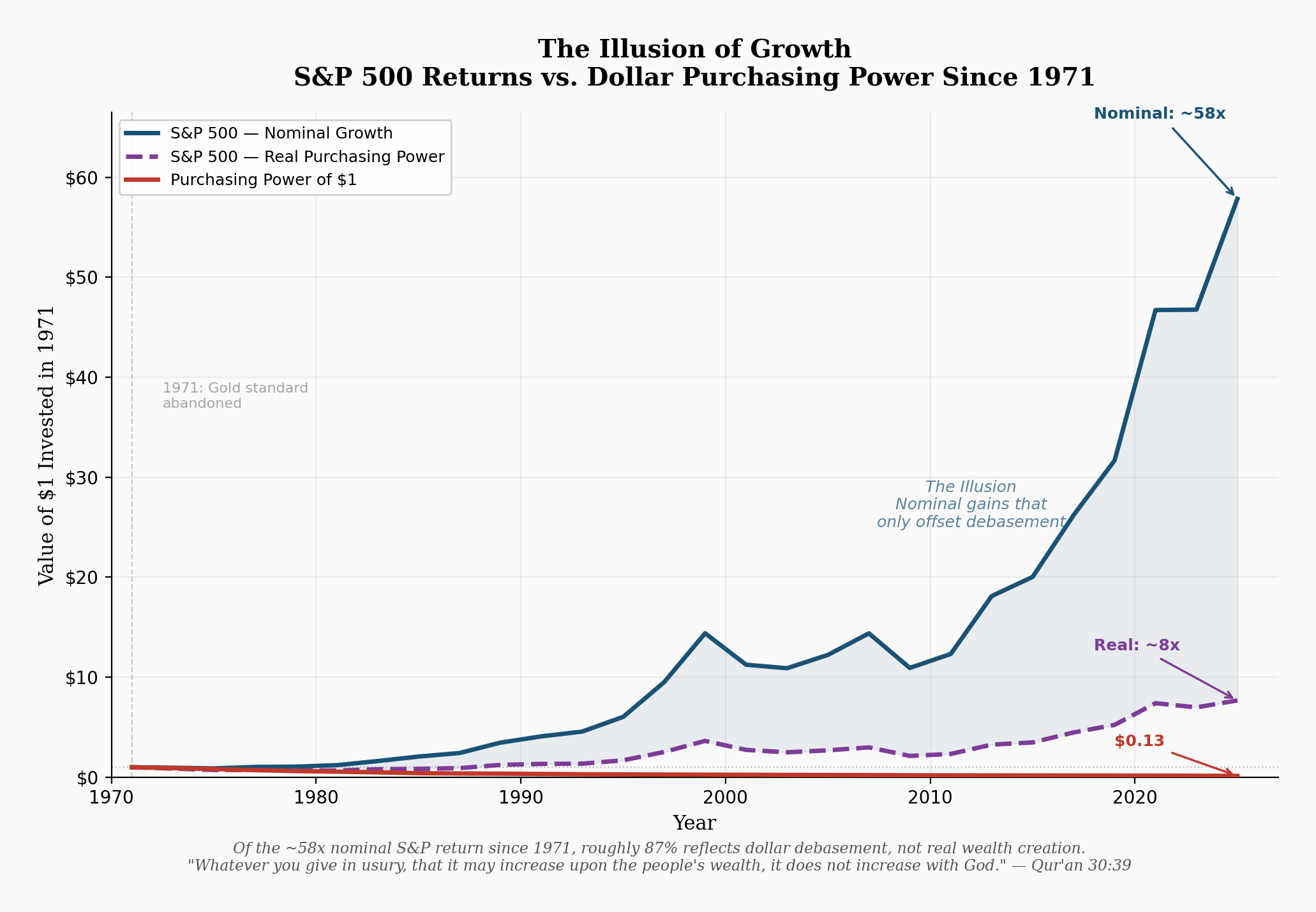
The accompanying figure illustrates this with uncomfortable clarity. Since 1971—the year the United States severed the dollar’s last connection to gold—the S&P 500 has delivered a nominal return of approximately fifty-eight times the original investment. This looks like extraordinary wealth creation. But when adjusted for the purchasing power the dollar has lost over the same period—eighty-seven percent of its 1971 value—the real return shrinks to roughly seven and a half times (index price only; dividends would raise both figures). The vast majority of what the market “gained” was not wealth created. It was purchasing power destroyed and then partially recovered through exposure to assets that rose in nominal price precisely because the money was being debased. Interest and equity returns, in this light, are not compensation for productive risk. They are a treadmill—the minimum speed required to avoid losing ground in a system that is quietly confiscating your wealth through inflation. The Qur’an’s verdict—it does not increase—is not a theological abstraction. It is, measured against the data, an empirically precise description of what has occurred.
Loading…
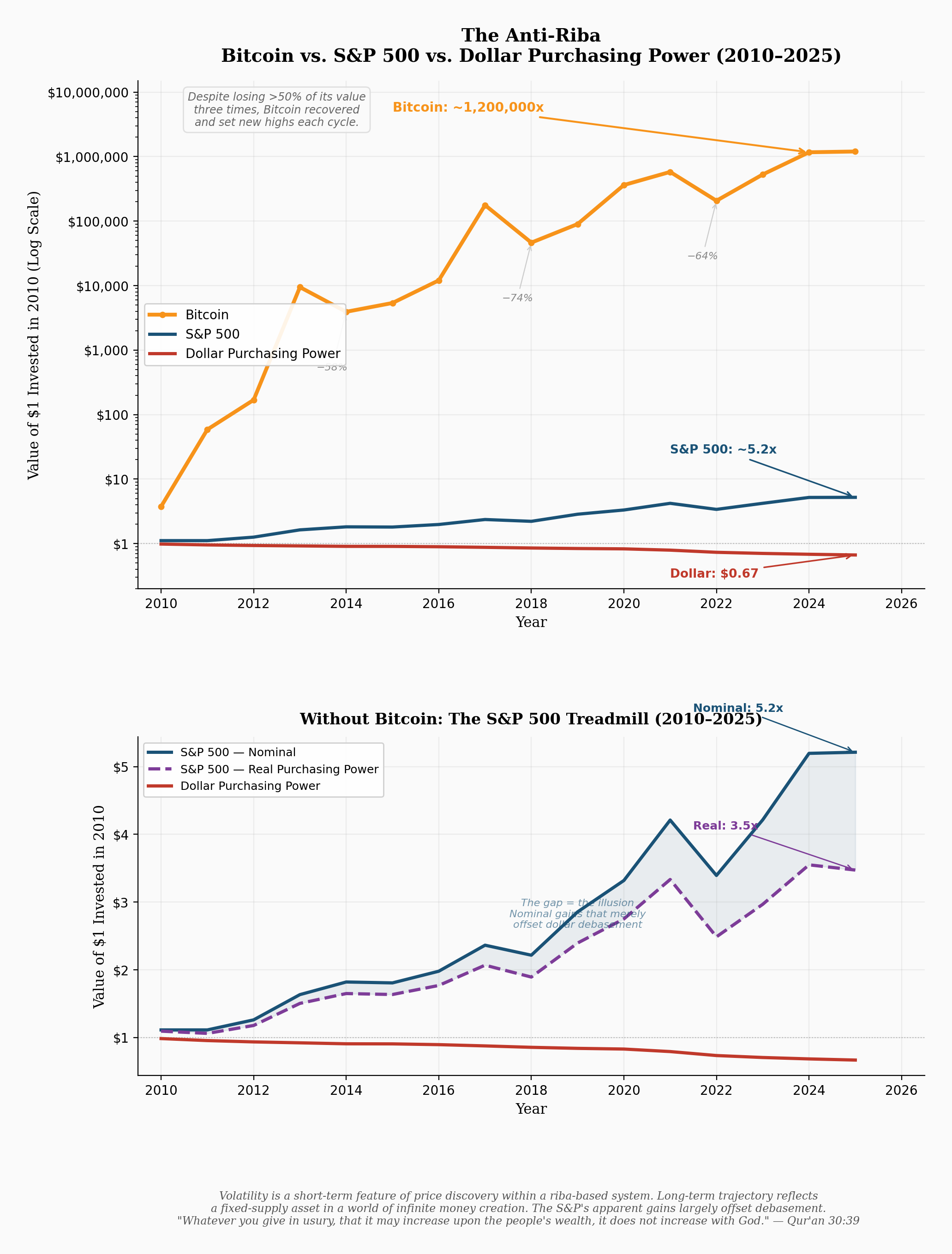
A second figure extends this analysis to include Bitcoin since its inception. The contrast is staggering. From the end of 2010 to the end of 2024, the S&P 500 index price rose about 4.7 times, or about 3.2 times in real terms after adjusting for the dollar’s roughly 31 percent loss of purchasing power. Bitcoin, measured from its first exchange prices of about $0.08 in July 2010 to $93,429 at the end of 2024, rose roughly 1.2 million times. The critic will immediately note Bitcoin’s extraordinary volatility—it has suffered peak-to-trough declines of roughly 75–90 percent at least four times (2011, 2014–15, 2018, 2022), and other drops of more than half—and the objection is fair. But here the chapter asks the reader to distinguish between short-term price behavior and long-term trajectory. Bitcoin’s volatility is a feature of price discovery within a riba-based system: it is priced in fiat currency, traded on exchanges that operate within the existing financial architecture, and subject to the speculative cycles that interest-bearing debt creates. The volatility is the noise of the old system encountering the new one. The trajectory—a fixed-supply asset appreciating against an infinitely expandable monetary base—is the signal. Every cycle, Bitcoin has crashed. Every cycle, it has recovered and established a new floor above the previous peak. The S&P 500, by contrast, has spent fifteen years running on the treadmill, and its real gain, about 3.2 times, is a fraction of its nominal one. One of these assets operates within the riba system. The other was designed, from its first line of code, to exist outside it.
Loading…
The Hoarding Objection
Economists trained in inflationary models will immediately object: if money always increases in purchasing power, why would anyone spend it? If your bitcoin buys more tomorrow than today, rational self-interest says hold everything and buy nothing. The economy freezes. Deflation becomes a trap.
This objection sounds compelling in theory, but it dissolves against observable reality. The technology sector has operated on a deflationary curve for decades. A computer purchased today will be outperformed by a cheaper model next year. A smartphone bought in January can be had for less by December. And yet people do not stop buying technology. They buy it when they need it, because human beings have needs that are immediate and ongoing. People buy food, shelter, clothing, transportation, and tools because they require them—not because they fear their money will be worth less tomorrow. Deflation does not freeze an economy. It disciplines one. It rewards patience, punishes speculation, and returns to each person the full value of their labor without the silent erosion of inflation.
There is a deeper irony here. Inflationary economics requires people to spend and borrow, because holding money means losing wealth. This compulsive spending is presented as economic health. But it is, in essence, a system that punishes saving and rewards debt—precisely the inversion of the Qur’anic economic framework, which repeatedly praises charity (voluntary giving) and condemns the compounding of financial obligation. The Qur’an envisions an economy in which people give freely from genuine surplus, not one in which they are driven to consume and borrow by the artificial erosion of their earnings.
The Existing Islamic Banking Sector
Islamic finance is not a theory waiting to be tried. It is a global industry. The Islamic Financial Services Board estimates total assets at about US$3.88 trillion in 2024, up 14.9 percent in a year, and its 2026 report puts the figure at about US$4.4 trillion for 2025, with banking over 70 percent of the total. The ICD–LSEG Islamic Finance Development Report, which uses a broader scope, puts 2024 assets at US$5.98 trillion across 140 countries. The industry traces its modern origin to the founding of Dubai Islamic Bank in 1975.
Its main instruments replace the interest-bearing loan with a sale, a lease, or a partnership. In murābaḥah, the bank buys an asset and resells it to the client at a disclosed markup, paid in instalments. In ijārah, the bank owns an asset and leases it, often with a path to ownership. Ṣukūk are certificates that represent ownership in underlying assets or projects rather than a debt claim. Muḍārabah and mushārakah, the profit-and-loss-sharing contracts discussed earlier, are the forms the jurists most closely associate with the Qur’anic ideal.
The common critique, voiced by economists and by Islamic scholars alike, is that much of this industry reproduces interest in form-compliant wrapping (El-Gamal, Islamic Finance: Law, Economics, and Practice, 2006). Markups are benchmarked to conventional interest rates. Profit-and-loss-sharing contracts form a small share of portfolios. Mechanisms such as commodity murābaḥah (tawarruq) let banks create what is economically a cash loan, and the IFSB’s own 2025 report flags heavy reliance on these “hybrid instruments” as an emerging vulnerability. Above all, Islamic banks operate inside a monetary system whose base money is created through interest-bearing credit and whose reserves are managed by central banks that set interest rates.
Attempts to change the money itself, rather than the contract, have been rare. No country requires full-reserve banking. Iceland’s Prime Minister commissioned a report proposing a sovereign-money system in 2015, and nothing came of it; Switzerland put a similar proposal to a national vote in 2018, and about 76 percent of voters rejected it. A few new institutions, such as N3XT and Zenus Bank, have adopted a full-reserve, no-lending model, though neither presents itself as Islamic.
This is the bridge to the argument of this chapter. Islamic finance has largely tried to make individual contracts riba-free while leaving the underlying money untouched, and the result often mirrors the system it set out to replace. The question this chapter asks is different: what would it look like if the money itself, not just the contract, were free of interest-bearing debt at its point of creation?
The Objection on Bitcoin’s Permissibility
We anticipate an objection that must be met directly: if Bitcoin is the structural anti-riba, why do some Islamic scholars rule it impermissible?
The answer lies in what those scholars are actually evaluating. The scholarly debates around Bitcoin’s permissibility center almost entirely on two concerns: its price volatility (which some classify as gharar, or excessive uncertainty) and its use in speculation (which some classify as maysir, or gambling). These are legitimate concerns within Islamic jurisprudence, and they deserve serious consideration.
Most published objections are not framed as concerns about riba. Rulings against Bitcoin, such as Egypt’s Dar al-Ifta (2018) and Turkey’s Diyanet (2017), have centred on gharar, potential for harm, and the absence of a recognised issuer. Riba questions do arise in the scholarly literature, but mainly about how Bitcoin is exchanged and lent — currency-exchange rules, interest-bearing crypto lending — not about how the protocol issues coins. On the specific question of whether Bitcoin’s architecture eliminates the mechanisms the Qur’an condemns—money generated from nothing, debt compounding on itself, wealth concentrating among those who control the money supply—the protocol’s answer is clear: it creates no money from debt and compounds no debt on itself, though the concentration of holdings and mining in the ecosystem built on it is another matter. That is a matter of protocol design, not jurisprudential opinion.
This chapter does not make a fiqh ruling. It does not claim that Bitcoin is halal, and it does not advise the reader to purchase it. What it observes is a structural correspondence between the economic principles the Qur’an articulated fourteen centuries ago and the architectural properties of a technology that emerged in the aftermath of the very crisis those principles warned against. Whether that correspondence carries theological significance is a question for qualified scholars. Whether it exists is a question of engineering, and the engineering is clear.
One final objection on Bitcoin must be addressed with full honesty. While the Bitcoin protocol itself cannot create money from debt, the ecosystem that has grown around it already includes lending platforms, custodial services, and derivative instruments that reproduce some of the mechanisms the protocol was designed to prevent. Third-party platforms offer yield on deposited bitcoin. Wrapped versions of bitcoin circulate on other blockchain networks with varying degrees of reserve backing. Some custodial services may hold fractional reserves against customer deposits. These are real phenomena, and they are worth acknowledging. It must also be said that Bitcoin remains, as of this writing, highly volatile—having fallen by roughly 75–90 percent from a peak at least four times in its short history—and that it has not yet achieved widespread use as a unit of account or a medium of everyday exchange. These are genuine limitations, not minor footnotes.
But the distinction matters. In the fiat system, riba is embedded at the foundational layer. The base protocol—the mechanism by which dollars are created—is itself built on interest-bearing debt. There is no version of the dollar that exists without riba, because riba is how dollars come into being. In Bitcoin, the base protocol creates money through proof-of-work. No debt is generated. No interest accrues. If every lending platform, every custodial service, and every derivative exchange built on top of Bitcoin were to collapse tomorrow, the Bitcoin network would continue to operate exactly as designed. The protocol layer is structurally anti-riba. What people choose to build on top of it is a matter of human behavior, not architectural inevitability. The fiat system makes riba inescapable by design. Bitcoin makes it optional—and that is a fundamental difference.
The Trajectory
There is one more dimension to this alignment that deserves mention—not as a prediction, but as an observation about the direction in which several converging technologies are pointing.
The modern economy is built on scarcity that is, in many cases, artificially maintained. Money is scarce because central banks control its supply. Energy is scarce because its generation depends on finite, extractable fuels controlled by a small number of producers and distributors. Labor is scarce because human beings can only work so many hours. In a system defined by these scarcities, interest seems rational—even inevitable. If everything is limited, then the use of any resource over time carries an opportunity cost, and that cost must be compensated. Riba, in this view, is simply the price of time in a world of constraints.
But multiple technologies are now converging in ways that erode these constraints simultaneously. Artificial intelligence is beginning to perform tasks that previously required human labor—not merely routine tasks, but complex analysis, creative work, and decision-making. If this trajectory continues, and there is little reason to believe it will not, the cost of many forms of productive output will fall toward zero. Advances in energy technology—whether from nuclear fusion, next-generation solar, or sources not yet fully understood—point toward a plausible future in which energy itself becomes abundant and inexpensive. And a fixed-supply monetary system like Bitcoin ensures that whatever prosperity these technologies generate is reflected in the increasing purchasing power of every unit of money, rather than being captured by those who control the money supply.
In such a world, riba does not merely become prohibited. It becomes pointless. If AI reduces the cost of goods and services toward negligibility, if energy becomes abundant, and if money cannot be inflated—then there is nothing for interest to compensate for. The entire economic framework that makes riba seem necessary collapses. Not because a religious text commanded it to, but because the material conditions of human life changed in ways that made the command self-evident.
The Qur’an did not merely say do not practice riba. It said that riba does not truly increase ()—that its apparent growth is illusory. It described riba not as a permanent feature of economic life to be managed and regulated, but as a fundamental distortion that would one day be recognized as such. It declared war on it—not the measured disapproval of a minor vice, but the total rejection of a system-level threat. If the trajectory of artificial intelligence, abundant energy, and sound money leads where it appears to lead, then the Qur’an’s severity was not an overreaction to 7th-century moneylending. It was a verdict delivered in advance on an entire economic paradigm—a paradigm that is, perhaps for the first time in fourteen centuries, beginning, on this chapter’s reading, to show structural cracks.
The Pattern
The pattern we have observed throughout this book repeats: the Qur’an makes a claim that seems, in its original context, to exceed what the available evidence warrants. Then time passes. Then the evidence catches up.
A skeptic might call this post-hoc reasoning—the tendency to see predictions fulfilled only after the fact. The charge is serious and deserves a serious response. Post-hoc reasoning works when the original text is vague enough to accommodate multiple interpretations. Nostradamus’s quatrains can be “fulfilled” by almost any major event because they are written in ambiguous, symbolic language that means nothing specific. If the Qur’an’s economic language were similarly vague—if it merely said “be careful with money” or “do not be greedy”—the charge of retrofitting would stand.
But the Qur’an does not say “be careful with money.” It says ad’āfan mudā’afah—doubled and multiplied. It describes those who consume riba as rising “like one whom Satan has struck into madness” — a scene the classical exegetes, al-Ṭabarī and Ibn Kathīr among them, set on the Day of Resurrection, and which this book also reads, as the author’s own interpretation, against the worldly behaviour of riba-driven markets. It declares war on behalf of God against those who persist. It distinguishes riba categorically from trade (ahalla Allāhu al-bay’a wa-ḥarrama al-riba) rather than treating them as a spectrum. These are specific, concrete, testable claims about the nature and consequences of interest. They are not poetry susceptible to any reading. They are a diagnosis with identifiable features.
And critically, if the argument were purely post-hoc, it would work equally well with other ancient texts. The Torah prohibits lending at interest to a fellow Israelite, naming both neshekh (“bite”) and tarbit/marbit (“increase”) (Leviticus ; cf. Exodus , Deuteronomy ). It does not, however, describe interest as “doubling and multiplying,” attach an image of madness to it, or declare divine war against those who persist. Aristotle critiqued interest as “unnatural”—but he did not describe it in the specific, mechanical terms the Qur’an uses. If we were retrofitting, we could retrofit any ancient text that mentions usury. We cannot. The Qur’an’s language is more specific than its contemporaries on precisely the points that the modern world has confirmed.
As discussed in the introduction, the Qur’an itself contains explicit markers—the phrase in kuntum taʿlamūn, “if you only knew” ()—signaling that its commands carry justifications exceeding the audience’s current knowledge. The fasting command is the clearest precedent: modern science has since confirmed health benefits the 7th-century audience could not have known, precisely as the text indicated. The pattern applies here with equal force.
The Qur’an could not explain fiat currency, central banks, or fractional reserves. It said: interest doubles and multiplies. It said: they will rise as one struck into madness. It said: what appears to grow through riba does not truly increase. It said: this is war from God. It used the most precise terms available—ad’āfan mudā’afah, yatakhabbatuhū al-shayṭān min al-mass, fa’dhanū bi-ḥarbin min Allāhi wa-rasūlihi—and the vocabulary was calibrated to the lexicon of the time. The charge of post-hoc reasoning assumes the text was trying to describe modern finance and failed to be specific enough. The text was not trying to describe modern finance. It was issuing a command with the strongest possible language, signaling that its severity carried justifications the audience could not yet see, and using terms whose precision would only become fully legible centuries later. That is not retrofitting. That is a text whose accuracy was built to outlast its audience’s comprehension.
What Could Constitute Sound Money
This chapter does not argue that Bitcoin is endorsed by the Qur’an, that it is the only permissible form of money in Islam, or that every Muslim should purchase it. These are questions for qualified scholars of Islamic jurisprudence, and they involve considerations—volatility, regulatory status, practical utility—that fall outside the scope of this book.
What this chapter argues is narrower and more defensible: that the Qur’an’s condemnation of riba was expressed with a severity that only becomes comprehensible when viewed against the backdrop of the modern global financial system. And that the structural properties of the most prominent alternative to that system align, point by point, with the economic principles the Qur’an articulated fourteen centuries ago.
A clarification is warranted here. Bitcoin was selected for analysis in this chapter not because this book argues it is the monetary system ordained by the Qur’an, or that no better system could exist. It was selected because it is the only functioning, real-world monetary network whose architecture structurally eliminates the mechanisms the Qur’an condemns—fixed supply, no central issuer, no interest-bearing debt creation—and because it has generated over fifteen years of observable market data against which those structural claims can be tested. It is, in short, the closest existing approximation to a non-riba monetary system, and the only one with enough history to analyze rigorously. Whether a superior system will emerge—one that better satisfies the Qur’an’s economic principles while addressing Bitcoin’s current limitations—is an open question this chapter does not foreclose. What it observes is that the structural correspondence exists, that the data supports it, and that no other system currently operating offers a comparable case for examination.
This distinction matters because Bitcoin as it exists in 2026 is not identical to Bitcoin as a protocol design. Mining has concentrated among a small number of industrial operators. The majority of Bitcoin held by institutions now sits inside the custody infrastructure of the same regulated financial system this chapter critiques. Exchange-traded funds have made Bitcoin accessible, but they have also made it a line item in the very portfolios built on interest-bearing debt. Energy consumption remains a live debate. These are real limitations, and this chapter does not dismiss them. But they are limitations of adoption and practice—not of the underlying architecture. The structural properties this chapter identifies—fixed supply, the impossibility of interest-bearing debt creation, the absence of a central issuer—are properties of the protocol itself, and they remain intact regardless of what the financial industry has built on top of it. The chapter’s argument rests on that architecture, not on any claim that Bitcoin’s current ecosystem fully embodies the economic principles the Qur’an articulates.
The Qur’an said that what appears to grow through riba does not truly increase with God (). The modern world has produced a monetary system in which the apparent growth of money through interest is, in fact, the systematic erosion of real wealth for the majority of humanity. And it has produced, in the same generation, a technology that makes the compounding of debt impossible by design.
Whether that is coincidence or confirmation is, as always, left to the reader.
The Claim in Brief
The same five questions close every evidence chapter, so the claims can be compared on the same terms. Scores and verdicts are deliberately left out.
| What does the text say? | The chapter reads , , (God has permitted trade and forbidden riba) and as forbidding a predetermined, guaranteed return on lending while permitting shared profit and loss, and on that basis argues that Bitcoin’s protocol is an unusually precise negation of riba-based money — an alignment it calls architectural rather than theological. |
|---|---|
| What would we expect historically? | Earlier sources had condemned interest — the Torah forbids lending at interest to a fellow Israelite (Leviticus ), and Aristotle called interest unnatural — but neither describes interest as doubling and multiplying, attaches madness to it or declares divine war on it, and a seventh-century text could not have described fiat currency, central banks or fractional reserves. |
| What is the strongest supporting evidence? | New bitcoin is created through proof-of-work with no debt and no interest, its supply is capped at just under twenty-one million by the consensus of independent nodes, and on-chain it cannot be fractionally reserved. A fixed supply removes the inflation justification for interest, while muḍārabah and mushārakah still reward risk through shared outcomes; the chapter reads the S&P 500’s rise since 1971 — about fifty-eight times nominal, about seven and a half times real (index price only) — as bearing out . |
| What is the strongest objection? | Time preference and default risk exist whatever the monetary system; the ecosystem around Bitcoin (yield platforms, wrapped tokens, custodians that may hold fractional reserves) reproduces some of what the protocol prevents; Bitcoin has fallen roughly 75–90 percent from a peak at least four times; and rulings against it, such as Egypt’s Dar al-Ifta and Turkey’s Diyanet, rest on gharar, potential harm and the absence of a recognised issuer. The charge of post-hoc reasoning is serious. |
| What remains unresolved? | The chapter makes no fiqh ruling, does not call Bitcoin halal or advise buying it, and leaves open whether a better non-riba system will emerge. Bitcoin is not yet widely used as a unit of account, mining has concentrated, and its energy use is debated, so the case rests on the protocol, not the present ecosystem; whether the correspondence is coincidence or confirmation is left to the reader. |